alskuefhaih
asoiefh
Showing posts with label war. Show all posts

Monday, March 12, 2012

Poem: Spring again, and Bill Evans' "Peace Piece"

-
-


Can it be a year since the Japanese tsunami, and the flowering of the Arab Spring? These, as well as horrors in other places, and Bill Evans' "Peace Piece" were on my mind all morning while this small poem came together. Yesterday it was warm for Michigan, in the 60s (15-20°C); beds got raked out, revealing crocuses in bloom. After a while, listening to the songs and calls of the birds, I could hear them say things I wanted to say. Which led to the Bill Evans song, because it also gives me calm beauty when I need it. And then the poem, which only seems to offer a bit of a framework for far more that wants to be said, and you know, sometimes only improvised songs can do it. You can read this back story about Bill Evans' intoxicating song "Peace Piece," recorded in 1958, including how he did not much like performing it upon request, as it was an inspiration of the moment, not something that could be recreated. Thankfully it was recorded, so it can be listened to, with peace rising like spring again and again.

Spring again

Woodpeckers nail octaves
to limbs
in another delicate scaffold of spring

while the mourning dove
coos a bass ostinato
out of

the bottom line,
ever below
the laughing glissando

of the Northern Flicker
and the
tinkling dee-dee-dee

of the chickadee;
note by ceremonial note
their steady spirit

tinkers with my hammering heart
to build even just one season
of peace, peace.

March 2012


-
-

Thursday, May 05, 2011

My response to the killing of Osama bin Laden

-
-


What color is prayer?

In December we saw an installation by visual artist Jitish Kallat at The Art Institute of Chicago called Public Notice 3. (The Art Institute's page about it is here.)

In thousands of LED lights, Kallat spells out words on the risers of the stairs in the Woman's Board Grand Staircase — an open, radiant space. The brightly lit words were intentionally designed in the five colors of the United States Department of Homeland Security alert system. At first, seeing the neon-like letters mounted on the Beaux-Arts stairs felt jarring. The Art Institute is my favorite museum, and the multi-directional staircase under a skylight has always been a magnetic center of the million-square-foot building where I love to sit and watch people, listening to the echo of voices and footsteps. Once I learned the content of the words illuminating the risers, I read up and down and watched people climb, descend, sit, stand, and snap pictures. We were surrounded by words like stock exchange tickers (though not in motion, and not driven by commerce).

Kallat said,  "Treating the museum’s Grand Staircase almost like a notepad, the 118 step-risers receive the refracted text of the speech. I see Public Notice 3 as an experiential and contemplative transit space; the text of the speech is doubled at the two entry points on the lower levels of the staircase and quadrupled at the four exit points at the top, multiplying like a visual echo."


more photos here

What speech? The words Kallat mounted on the stairs were spoken by Hindu monk Swami Vivekananda to 7,000 delegates more than 100 years ago, in the first attempt to address religious tolerance worldwide: the First World Parliament of Religions, held in conjunction with the 1893 Chicago World's Fair. (Detailed synopsis of the Parliament at Boston University's Encyclopedia of Western Theology's site here.) This art installation was opened last year on the tenth anniversary of the 9/11 attack, September 11, 2010. Part of what captured Jitish Kallat's imagination was the fact that the gathering of delegates of different faiths in 1893 in the museum's Fullerton Hall happened also to be on September 11 that year. Below is Vivekananda's speech, words that light the steps of the grand staircase like prayers rising and falling, adjacent to the hall where he addressed the hopeful delegates. (The building of the Art Institute was built for the 1893 Chicago World's Fair — officially the World's Fair: Columbian Exposition — with the agreement that it would house the Art Institute thereafter).

When you get to the last sentence of his speech, what do you feel?


Swami Vivekananda's speech to the First World Parliament of Religions, September 11, 1893 in the Art Institute of Chicago's Fullerton Hall:

Sisters and Brothers of America,

It fills my heart with joy unspeakable to rise in response to the warm and cordial welcome which you have given us. I thank you in the name of the most ancient order of monks in the world; I thank you in the name of the mother of religions, and I thank you in the name of millions and millions of Hindu people of all classes and sects.

My thanks, also, to some of the speakers on this platform who, referring to the delegates from the Orient, have told you that these men from far-off nations may well claim the honor of bearing to different lands the idea of toleration. I am proud to belong to a religion which has taught the world both tolerance and universal acceptance. We believe not only in universal toleration, but we accept all religions as true. I am proud to belong to a nation which has sheltered the persecuted and the refugees of all religions and all nations of the earth. I am proud to tell you that we have gathered in our bosom the purest remnant of the Israelites, who came to Southern India and took refuge with us in the very year in which their holy temple was shattered to pieces by Roman tyranny. I am proud to belong to the religion which has sheltered and is still fostering the remnant of the grand Zoroastrian nation. I will quote to you, brethren, a few lines from a hymn which I remember to have repeated from my earliest boyhood, which is every day repeated by millions of human beings: "As the different streams having their sources in different paths which men take through different tendencies, various though they appear, crooked or straight, all lead to Thee."

The present convention, which is one of the most august assemblies ever held, is in itself a vindication, a declaration to the world of the wonderful doctrine preached in the Gita: "Whosoever comes to Me, through whatsoever form, I reach him; all men are struggling through paths which in the end lead to me." Sectarianism, bigotry, and its horrible descendant, fanaticism, have long possessed this beautiful earth. They have filled the earth with violence, drenched it often and often with human blood, destroyed civilization and sent whole nations to despair. Had it not been for these horrible demons, human society would be far more advanced than it is now. But their time is come; and I fervently hope that the bell that tolled this morning in honor of this convention may be the death-knell of all fanaticism, of all persecutions with the sword or with the pen, and of all uncharitable feelings between persons wending their way to the same goal.

After reading this speech, I feel as I did when I woke up early Monday morning, before Don, to his hand written note from the night before after he'd heard the news and I was in bed. I feel: empty. Not joyful. Not sad exactly. Not hopeful, not hopeless. I'm somewhere floating in a noxious ether of mystery. How have we come to this? How did we get even further away from Vivekananda's closing wishes in these decades since he spoke them?


To watch and listen to an 8-minute video of artist Jitish Kallat's interview with the museum curator about his installation, go here.

-
-

Sunday, October 31, 2010

Horrors transcended

-
Happy Halloween! I love how this day gives us a chance to play with fright and pretend we're someone else (and eat Reese's peanut butter cups).

Just before our mid-term elections here in the U.S., while politicians flood the air waves with last ditch efforts to get voters out Tuesday, Comedy Central's Jon Stewart and Stephen Colbert held a Rally to Restore Sanity on Washington DC's mall, which brought out well over 200,000 people. Was the rally to support a political party or candidate? No. In his comments at the end of the comedic and musically entertaining event, Stewart asks, What exactly was this? What was the point? His point was to pull back from 24-hour media pundit craziness-inducing overreactions of the Left and Right and remind us that we are not made up of those caricature-warped portrayals of us Americans. I take great hope from the success of this rally that called out hate and reminded us not to let ourselves be driven by the media's polarizing takes on reality.

I'd like to use this moment when politics are all we're hearing on the TV and radio, on Halloween's day of pretend horrors, to talk about three of our human species who truly suffered under another kind of horror, the political kind. While I complain about the faulty systems of my country and the inefficacy of politicians to fix the mess, and while I feel myself getting more cynical and disengaged (but I will force myself to stop at City Hall on the way to work Tuesday to exercise my right to vote), there are far worse political nightmares in the history of the world. The three people I'm spotlighting lived through some of the most terrifying realities of the 20th century. Yesterday, October 30, was not only the day of the Rally to Restore Sanity, it was Miguel Hernández's centenary birthday. He is the third person in my spotlight, below. In the poem of his I share, he says something like Jon Stewart said yesterday:


You are the body of water
that I am— we, together,
are the river
which as it grows deeper
is seen to run slower, clearer.


Besides perspective-taking in today's context of political lunacy, this is also about the power of language and poetry to not only express the inexpressible, but to sustain us, even when life is at its most dire. Whether in the reading of it, or in writing it, these three show that poetry can transcend the worst that mankind offers and lift us on powerful and delicate wings into the shining sun at the core of ourselves.

For further biographical information on each of these three, please click on their names.

Nelson Mandela, Prisoner 466/64, born 1918
After spending more than twenty years working for equal rights for Blacks in apartheid-heavy South Africa, Nelson Mandela was arrested for sabotage and sentenced to life in prison. He served almost 27 years in three prisons – Robben Island, Pollsmoor Prison and Victor Verster Prison, until his release in 1990. He was elected President of the African National Congress in 1991, received the Nobel Peace Prize in 1993, and was elected the first black President of South Africa in 1994. He said, “In my country we go to prison first and then become President.”

Nelson Mandela said the poem Invictus sustained him through his nearly 27 years in prison.

Invictus
by William Ernest Henley

Out of the night that covers me,
Black as the Pit from pole to pole,
I thank whatever gods may be
For my unconquerable soul.

In the fell clutch of circumstance
I have not winced nor cried aloud.
Under the bludgeonings of chance
My head is bloody, but unbowed.

Beyond this place of wrath and tears
Looms but the Horror of the shade,
And yet the menace of the years
Finds, and shall find, me unafraid.

It matters not how strait the gate,
How charged with punishments the scroll.
I am the master of my fate:
I am the captain of my soul.


Anna Akhmatova, 1889 - 1966
"Before this sorrow mountains bow . . ."
Poet Anna Akhmatova lived during the most turbulent time of Russian history, and though she was not herself imprisoned by the Bolsheviks, her first husband, after their divorce, was executed, and her son imprisoned for seventeen months. Most of those closest to her were exiled, imprisoned or executed for their political leanings. Her poetry was banned, she lived under surveillance. Her masterpiece about the horrors and sorrows of Stalin's death camps, Requiem, was written and dedicated to the women she met standing outside Leningrad's Kresty Prison while her son was imprisoned there. The poem was not published until after her death. Please do read the entire poem in the link above. Here is one stanza from Requiem, followed by a poem called Solitude that speaks to her own lack of freedom and the writing that sustained her.


from Requiem
by Anna Akhmatova

5

Seventeen months I’ve pleaded
for you to come home.
Flung myself at the hangman’s feet,
my terror, oh my son.
And I can’t understand,
now all’s eternal confusion,
who’s beast, and who’s man,
how long till execution.
And only flowers of dust,
ringing of censers, tracks just
running somewhere, nowhere, far.
And deep in my eyes gazing,
swift, fatal, threatening,
one enormous star.
(Translated by Yevgeny Bonver)

Solitude
by Anna Akhmatova

So many stones are thrown at me
that I no longer cower,
the turret’s cage is shapely,
high among high towers.
My thanks, to its builders,
may they escape pain and woe,
here, I see suns rise earlier,
here, their last splendours glow.
And often winds from northern seas
fill the windows of my sanctuary,
and a dove eats corn from my palm…
and divinely light and calm,
the Muse’s sunburnt hand’s at play,
finishing my unfinished page.

(I'm sorry, but I don't know who translated this version of "Solitude") 


Miguel Hernández, 1910 (October 30) - 1942
Yesterday was Miguel Hernández' centenary birthday. I didn't know about Hernández until my dear friend Lorenzo of The Alchemist's Pillow offered a beautiful look at him in his post called Cicada Dirge. This special birthday was hugely celebrated in Spain and around the Spanish-speaking world this weekend. Coming out of poverty and his father's adamant rejections of his literary and poetic interests, Hernández beat incredible odds to become one of the most admired Spanish poets. As a supporter and soldier of the anti-fascist Republican forces against Franco's Nationalists in the Spanish Civil war, he was arrested and sentenced first to death, and then life in prison when Franco took power. He didn't survive long in prison, as the terrible conditions led to his death by tuberculosis at the age of 31.

Post script: Lorenzo at The Alchemist's Pillow has posted a new commemorative essay called Milking a goat and a dream, tenderly showing more intimate details of Miguel Hernández's story. He plans to continue his series on Hernández in future posts as well.

The world is as it appears
by Miguel Hernández

The world is as it appears
before my five senses,
and before yours, which are
the borders of my own.
The others' world
is not ours: not the same.
You are the body of water
that I am— we, together,
are the river
which as it grows deeper
is seen to run slower, clearer.
Images of life—
as soon as we receive them,
they receive us, delivered
jointly, in one rhythm.
But things form themselves
in our own delirium.
The air has the hugeness
of the heart I breathe,
and the sun is like the light
with which I challenge it.
Blind to the others,
dark, always remiss,
we always look inside,
we see from the most intimate places.
It takes work and love
to see these things with you;
to appear, like water
with sand, always one.
No one will see me completely.
Nor is anyone the way I see him.
We are something more than we see,
something less than we look into.
Some parts of the whole
pass unnoticed.
No one has seen us. We have seen
no one, blind as we are from seeing.

(translated by Don Share)

Thursday, April 22, 2010

Reason to believe

-
-


BECOMING MILTON
by Coleman Barks

Milton, the airport driver, retired now
from trucking, who ferried me
from the Greenville-Spartanburg airport
to Athens last Sunday midnight to 2:30 A.M.,
tells me about his son, Tom, just back
from the Gulf war. "He's at Fort Stewart
with the 102nd Mechanized, the first tank unit
over the line, not a shot fired at them.
His job was to check the Iraqi tanks
that the airstrikes hit, hundreds of them.
The boy had never even come up on a car accident
here at home, twenty-four years old. Can you
imagine what he lifted the lid to find?
Three helmets with heads in them staring
from the floor, and that's just one tank.
He has screaming flashbacks, can't talk about it
anymore. I just told him to be strong
and put it out of his mind. With time,
if you stay strong, those things'll go away.
Or they'd find a bunker, one of those holes
they hid in, and yell something in American,
and wait a minute, and then roll grenades in
and check it and find nineteen freshly killed guys,
some sixty, some fourteen, real thin.
They were just too scared to move.
He feels pretty bad about it, truthfully,
all this yellow ribbon celebrating.
It wasn't a war really. I mean, he says
it was just piles and piles of their bodies.
Some of his friends got sick, started vomiting,
and had to be walked back to the rear.
Looks like to me it could have been worked
some other way. My boy came through OK,
but he won't go back, I'll tell you that.
He's getting out as soon as he can.
First chance comes, he'll be in Greenville
selling cars, or fixing them. He's good at both.
Pretty good carpenter too, you know how I know?
He'll tear the whole thing out if it's not right
and start over. There's some that'll look
at a board that's not flush and say shit,
nail it, but he can't do that, Tom."


Listen to Springsteen sing Reason to Believe:


-
-

Sunday, April 12, 2009

Visualize sleekness (and peace)

-
-


Now that winter is over, words like shorts, tank top, and swimsuit spring to mind. Yikes!

Pasty white legs and, you know, extra . . . softness that I was squeezing into winter clothes.

Another spring word: diet. Oh, and: treadmill (or as Susan says: dreadmill).

But wait, I just read one of the best ideas I've heard about getting fit, and it isn't the Zone or Atkins, Weight Watchers or Jenny Craig, macrobiotics or calorie counting. In fact it isn't dieting at all.

It's from the stuff about the law of attraction (such as in the book and film The Secret): What you focus on you attract more of to yourself. Rather than focusing on debt, for instance, focus on abundance. Or if like me, the wars in Iraq, Afghanistan and Gaza (etc., etc.) are driving you nuts, instead of focusing on what you hate about war, focus instead on peace. It really is a shift in perspective. And according to the law, you will begin attracting abundance and peace, or whatever it is you focus on. (I so appreciated Loring's post of the peace rally he participated in in Colorado Springs on the anniversary of the start of the Iraq war for how it focused on peace, and the words of MLK Jr: "Hate cannot drive out hate, only love can do that; hate only multiplies hate.") This is going to effect how, or if, I will continue to rant at huffing.

So, back to getting fit, "the first thing to know is that if you focus on losing weight, you will attract back having to lose more weight, so get 'having to lose weight' out of your mind. It's the very reason why diets don't work. Because you are focused on losing weight, you must attract back continually having to lose weight." Here's a whole excerpt on fitness from The Secret. Basically, stop blaming food for how you look. Then decide what is the weight you want to be, and visualize yourself at that weight. Start feeling good about your body, and you'll respect it.

That's what that pretty lady taped to our treadmill is representing: the fit me. I'm never going to be 22 again, or look like her, but I must say this has worked so far. When I suddenly crave a PayDay candy bar mid-afternoon between appointments, if I visualize her, the craving fades. I think: she wouldn't eat that right now, so neither will I. (Well she eats one sometimes.) Now I try to go to work prepared with string cheese and an apple for snacks. And on the treadmill, I straighten and lift my spine. Doesn't she have great posture? So do I, darn it!

Now, what to do about pasty white legs?

Saturday, March 21, 2009

Our cousin's military funeral

-
-


-

He signed up for the Marines when he graduated high school in 1973.


He served a few years. No one in the family knows what he did, he couldn't talk about it. He was a Marine on undisclosed missions in the Pacific.


Now, just before his 54th birthday, Don's cousin is gone, from congestive heart failure. What secrets were better left unsaid, that didn't take him to his grave, but he took them there?


Good night, David. Time to rest.


This was my first military funeral, though I've seen them on TV and in movies.

I was feeling sheepish about my camera until one of David's sisters met me going inside with "Thank you, none of us thought to bring one. I want the kids to have something to remember this by." From that point on, I felt complete freedom, with a purpose. If you know me, you know my protests against militarism. But it was time to set that aside and do something for the family.

Arriving at the cemetery we were greeted by a row of seven Marines holding rifles by their sides, poised in readiness for the 21-gun salute to come. I snapped several shots of their fixed faces before I went inside the mausoleum for the ceremony. Like the guards at Buckingham Palace, they were stoic and unmoving, barely breathing it seemed, in their stillness.

Inside, as the other three Marines fulfilled their ceremonial charge - one playing "Taps" on his horn outside the door, the other two marching up the aisle, then folding the flag in meditative precision - I felt calmed. When the rifles rang their 21 shots outside - each Marine firing three times in sync - and David's daughter burst into a sudden wail, I realized this is why we offer ceremony, why we turn to it in times of great sorrow and joy. In the silent, slow folding of the flag, how carefully they caressed it with their white gloves, how tightly they held it between them in their task of transformation. And I saw, as if for the first time, how beautiful our flag is. In those moments I didn't see borders, or patriotism, or war. I saw stunning, vivid colors in a bold design unlike any other flag in the world, and it had become a blanket covering a soldier at rest. A thing of comfort. And when the Marine handed David's widow the red white & blue fabric triangle I felt its power. Ah - the American flag, an instrument of healing!

I remember how I felt at age 7, perched on the floor in front of our black and white TV, watching Caroline Kennedy - one year younger than I - holding the hand of her mother dressed in black, in a veil. They walked up and touched her daddy's flag-covered casket in the vast Capitol rotunda - first her mother's black-gloved hand, followed quickly by her own small white-gloved hand - this girl with hair and white anklet socks like mine. Then her mother's kiss on the flag. They were us. We were being healed by ceremony.

If you're interested, you can view David's military honors in this YouTube slideshow.


Saturday, February 21, 2009

1996 Oscar: one scene in The English Patient


I watch few movies now, and I can't for the life of me list the nominees for Sunday night's Oscars show the way I once did, let alone say I've seen them all. I know there's Pitt and Winslet, a Slumdog and a Wrestler.

So I'll do what aging people do when they start losing touch with the changes around them: I'll reminisce. About a 1996 film about WWII, too famous and parodied for you to be ignorant of it. But even so, it gets me thinking about how sorry we all are for this fractured world, and sorry for ourselves too.

So, in the movie, there is brutal war among the world's powerful governments trying to shape boundaries and mindsets in the decades to come. Human beings and Nature together have grown soft and muddy with grief, hatred and killing.

For Hana war is not just a story in the news. She has watched her best friend explode in a jeep that hit a mine. Then in the hospital tent under mortar attack she has discovered that her lover, an officer in another regiment, has been killed. As a war nurse, her ears are deafened with bomb blasts and agonized whimpers of broken men. She holds their torn flesh and bones like crushed fruit.

So when Kip the mine sweeper carries her on his scooter into town for an escape and a surprise, Hana's whole body lights up with childish anticipation. They enter an empty church where frescoed murals adorn the walls up high. Too high, and invisible in an unlighted church. Kip harnesses her on a hanging rope with himself as counter-weight on the other end, hands her a flare after lighting it, and hoists her to the level of the paintings. He operates the rope deftly as if he has practiced this every night for a week, causing her to sway gently in a hanging dance that he controls so she can examine the painted faces up close while she twists and dangles.

Kip knew Hana could not extricate herself from the plodding pain engulfing her, just as he himself had struggled to block out the strain of his mine sweeping job. As love surprised them, he shared a secret window of art and joy with her. I appreciate the grace of the scene for showing two people crushed with war fatigue determined to absorb available beauty, for each others sake as much as for their own.


Friday, December 19, 2008

Lord Nelson & Sicilienne


I picked up these ornaments for Peter and Lesley in London's National Gallery gift shop in July 2005, just a week after terrorist bombs blew up a bus killing 52 people two blocks from the university dorm where I was staying. Our students studying film in Britain had heard and felt the blast. After I arrived a week later the air was still numb with shock, and with every siren's howl I watched Londoners on the sidewalk pause in suspense. The sailor here is Lord Horatio Nelson, I think, although I don't know that he lost an eye. It occurs to me now that Lord Nelson's arm lost in war is fitting for the time in which I bought these. Stupid wars.

I'm afraid I don't remember who the red dressed woman is supposed to be from the London gallery, but I've named her Sicilienne, after Gabriel Fauré's: Sicilienne Op.78 (Pelléas Et Mélisande) in the YouTube below, performed on cello by Julian Lloyd Webber (son of William Lloyd, and younger brother of Andrew Lloyd), and on piano by John Lenahan. Brilliant art.
--
Fauré wrote Sicilienne for the fairy tale play Pelléas Et Mélisande written by Maurice Maeterlinck who believed that human behavior is guided by two principles: Eros (erotic love) and Anteros (punisher of those who scorn love).
--
Love and revenge. Art and war. Brilliance and stupidity. That about sums up human history. I wish for more love-art-brilliance in the year ahead.


We're in the major snowstorm that has swept across the country - expecting 10-12 inches of snow. I hope everyone out there is safe, warm and fed. I've added these photos to show the snow sliding off the barn roof. Then the last one is from inside the deck window looking out at Don going to tend to his ladies in the coop to see how they're faring in the storm and also gather eggs.


Wednesday, December 05, 2007

poem


Advising the student who came back from Iraq in autumn


I asked him

What did I ask him?

Did I ask if he’s OK?
If “it’s” OK.
Are “things” OK?

He’d started college
before the tour, and now he said
he wondered if he’d be too dumb
for it, coming back.

My god I just go home, and I see maple leaves
scattered, covering the green
completely. And that is my life

going from here
to there,

seeing things to be gathered up
and reassembled

only to be scattered again.

-
Ruth Mowry
October 2007
-


Saturday, December 01, 2007

War, of all things


With 30,000 books on Vietnam, why write another? Tom Bissell, born in Escanaba, Michigan, after America’s involvement in Vietnam ended in 1973, says about his 2007 memoir The Father of All Things:

“I bring to the Vietnam War only this: I have spent most of my life thinking about it.”

His father served along with 3 million other Americans in Vietnam and saw combat along with 800,000 of them.

Some years ago Tom and his father John traveled to Vietnam together, and Tom wrote a magazine article about it, not realizing at the time it would develop into an obsession and a book. Tom’s father was deeply troubled after his Vietnam experience, which affected his struggling marriage and the raising of his boys. The trip to Vietnam drew Tom into a consuming exploration of the country, the war, and his own feelings about having a father who served there.

The flyleaf says:

. . . he “explores the many debates about the war, from whether it was winnable to Ho Chi Minh’s motivations to why American leaders lie so often. Above all, he shows how the war has continued to influence American views on foreign policy more than 30 years later.”

He wanted to interweave his emotional experience with the historical facts. He didn’t intend to write about “war’s endless legacy,” but it ended up being inevitable that he did so.

This is Tom’s fourth book, you can read the NYTimes book review here, and I posted about it in March. Back in 1993 I took ENG 453 Contemporary American Poetry with Tom, and our instructor was Professor Diane Wakoski, who became my poet mentor and has remained good friends with Tom. The three of us will have lunch together Monday, along with a couple of students and a fiction writing professor.

My department invited Tom to come back for a visit to talk with current English students about his life in writing. I get to truck him around campus Monday and Tuesday to meet with folks.

I started reading The Father of All Things yesterday. Nothing like cramming before the exam, er, I mean visit.

In the Introduction, Tom writes:

“War is a force of influence above all else—the most purely distilled form of partisanship ever devised. Yet war’s energies and dark matter are too complicated to allow anyone the certain physics of right and wrong. When war begins, leaders inevitably frown as they promise courage and bravery, guarantee tragic sacrifice, yet vow, all the same, to see it through. What any war’s igniters rarely admit are the small, terrible truths that have held firm for every war ever fought, no matter how necessary or avoidable: This will be horrible, and whatever happens will scar us for decades to come. Indeed, even necessary wars can destroy the trust of people in their leaders, just as war destroys human beings on both sides of the rifle.

War is appetitive. It devours goodwill, landscape, cultures, mothers, and fathers—before finally forcing us, the orphans, to pick up the pieces. These pages are, I hope, a few such pieces.”


Tuesday, June 12, 2007

to a Captain in Iraq

My friend Carrie's husband is a pilot in Iraq.

Don's 3rd graders wrote him letters.

Some of them said they want to be like him.


Derek is a wonderful man.

It makes me sad that he and Carrie are apart.

Thursday, June 07, 2007

Should some mistakes not be forgiven?


Photo of Günter Grass courtesy wikipedia under their free documentation license


I’m in the middle of reading Günter Grass’ personal history article in the New Yorker. More about that in a minute.

I was born in 1956, just eleven years after the end of WWII. Our kids were born about that length of time after the Vietnam war. Sometime in my youth I saw photographs from when Allied troops opened concentration camps in Germany where living skeletons with caves for eyes, and piles of bones like bonfire wood, awaited them. In 1975, on study abroad, I visited Dachau, saw the former factory buildings, the large shower rooms where people were to be gassed, their last memory seeing others dying, naked. Unlike Auschwitz, I don't believe Dachau was used for gassing after all, but many of its 200,000 prisoners died of malnutrition, disease and suicide.

Polish born German Günter Grass won the Nobel prize in literature in 1999 for his “frolicsome black fables portray[ing] the forgotten face of history . . . When Günter Grass published 'The Tin Drum' in 1959 it was as if German literature had been granted a new beginning after decades of linguistic and moral destruction.” He became a hero in Poland, and the world, for telling the stories that hadn’t been told.

In 2006, Günter Grass revealed that he had been a member of the Nazi Waffen SS after being silent about it for 60 years. Many criticized him for hypocrisy. He had been a hero in Gdansk and other places for his healing perspective on history through his writing as one who had been drafted into the armed forces. The Waffen SS, on the other hand, was originally not part of the armed forces, but was a brutal and ruthless arm of the Nazi party. He said that he thought his writing had been enough of a redemptive act and that the 1950s was not the right time to confess.

Many, including Lech Wałęsa, who had criticized him initially when he revealed his Wassen SS membership, eventually forgave him for making a mistake in his youth.

In the personal history he wrote for this week’s issue of the New Yorker, ten months after his Waffen SS membership revelation last August, Grass describes in horrifying detail what it was like to fight in the war (on the “wrong” side).

In the paragraph I just finished, he wrote:

“But I had already read everything I write here. I had read it in Remarque or Céline [WWI], who . . . were merely quoting the scenes of horror that had been handed down to them . . .”

It seems to me that when humans don’t learn from mistakes, they will repeat them, as the saying goes. When humans don’t forgive mistakes, they are making the kind of mistakes that start wars. And every war that’s started is just another mistake that begets the next generation of wars.

Monday, May 28, 2007

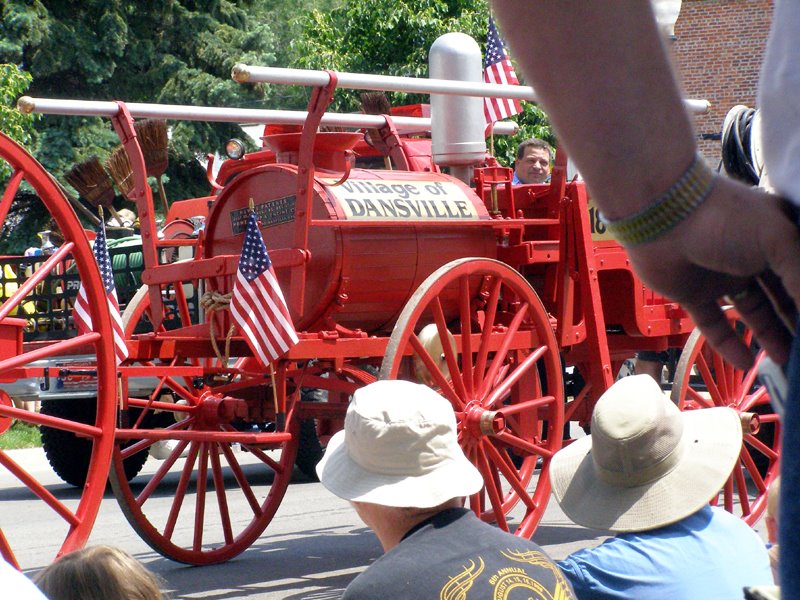
Memorial Day parade 2007

Thankfully, it was 20˚ cooler at this year's Memorial Day parade than last year's. Today it was a perfect 70˚F.


The director of the parade told the kids lining up, "This parade is not about you, it's about our veterans." This little guy saw me and my camera across the street and gave me a photo op smile every time I lifted the camera to my eye.


I got choked up when these WWII veterans walked by.


But when these loved ones of a soldier who died in Iraq came, I really lost it. All their t-shirts have a photo of him as well.


When I saw this man's t-shirt, I thought, oh brother! He's a real party-er. But later, after we got home, it dawned on me that his shirt may have been about the US war in Iraq.


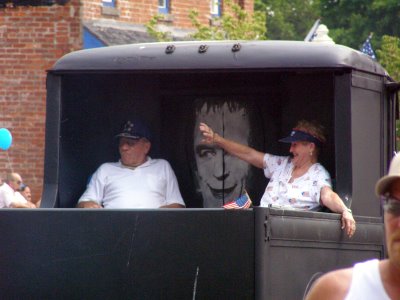
Here are Little Mr. Dansville and Little Miss Dansville.

Monday, September 11, 2006

9/11: what are you holding?


Not hatred. Not today. Not ever.

Love. Today. Forever.

Whichever way you look at it, let it push fear out.

Monday, August 28, 2006

War is a mind-set

Just read about another bomb in Antalya, Turkey. So I'm going to share what I read this morning:

"In certain cases, you may need to protect yourself or someone else from being harmed by another, but beware of making it your mission to 'eradicate evil,' as you are likely to turn into the very thing you are fighting against. Fighting unconsciousness will draw you into unconcsciousness yourself. Unconsciousness, dysfuntional egoic behavior, can never be defeated by attacking it. Even if you defeat your opponent, the unconsciousness will simply have moved into you, or the opponent reappears in a new disquise. Whatever you fight, you strengthen, and what you resist, persists." [my bold]

- Eckhart Tolle, A New Earth, page 74-75, Penguin Books, 2005

Wednesday, July 05, 2006

Independence Day Wish


Posted by Picasa
Here are my son and my nephew huddled with matches, risking life and limb (just kidding) to light our family's fireworks at the lake Sunday night.

The little display in the sky is about the level of enthusiasm I feel patriotically right now. I am happy to live in the United States, don't get me wrong. I lived in a less developed country for three years (Turkey). I appreciate convenience, availability of goods, democracy, freedom. I really do. I lived at another level in a place where telephone service was limited and stores were not open 24/7. But did I suffer? No. I actually suffered a bit returning to the States. I was overwhelmed by Choice, Glitz, Money. How long and how much for that ABC Monday Nite Football video extravanganza, for goodness' sake??

I'm embarrassed by the desire our current president has to control parts of the world. I understand it's about "our interests." But come on, the New American Century? How much hubris is that?

I don't want to start a political debate. I just want to state here, for the record, that on this Independence Day, I wish we were not at war in Iraq and Afghanistan. I wish we were not playing a missile game with North Korea. (As if THEY don't have the right to defend themselves when countries like ours are attacking countries we perceive as a threat without them attacking us.) I wish each of us would take responsibility for our own life and realize it is what I do that will matter. I have to think and live my life. I wish so many things, but I also wish to be at peace with things AS THEY ARE. I'm not waiting for things to change (even though I hope they will).

I get to say these things, because this is my blog. I hope I have not put a wall up between me and you. It's not important. It doesn't really matter in the long run. I just have to say it today.

Wednesday, June 14, 2006

It's just a window


Whatever your faith or persuasion, would you join me today by sending out loving energy across this violent world of ours? Listening to NPR coming to work this morning I felt ill listening to the news of Gaza, Iraq and the political meanderings of some silly suits.

We have personal power, and when we send it out as love and light, it is energy that creates rather than breaks down. Whether you pray, meditate, or whatever you do (or don’t regularly do) please join me and send LIFE out to a crazy, hate-filled world.

Where are we going to be 10 years from now if we don’t wake up??

Tuesday, May 30, 2006

Memorial Day parade


In the U.S., the last Monday of May is Memorial Day, mostly to remember fallen soldiers from our wars. But many of us also take the opportunity to visit graves of our loved ones who've passed on, unrelated to war.

I don't think I've been to a Memorial Day parade since I was a little girl, when I rode my bicycle in my hometown parade. I remember decorating my bike with red, white and blue crepe paper in the spokes of the tires. I was proud to ride across the bridge downtown.

So here is our even smaller home town's parade. It was hotter than blazes, but thousands of us turned out to honor our war veterans and fallen soldiers.

I hate war, so don't get me started. But I got teary watching the beautiful old men and women who served in WWII, and the Vietnam vets who are starting to look about as old as me.

In our small farm town, everyone who can or wants to rides in the parade. After the vets come the antique cars and tractors. Here's an interesting one.

Monday, February 06, 2006

Rough Justice

I couldn’t help but notice a contrast between the hands of two men in the media in the last 24 hours.

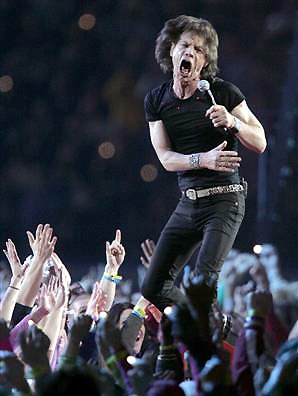
In the Super Bowl half time show last night, Mick Jagger’s limbs, pelvis, head, mouth – everything – moved in unbelievable possibilities on the Rolling Stones’ giant pack-n-play mouth-n-tongue stage.


AP Photo/Amy Sancetta

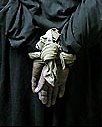
Today Abdel Fattah Abdel Razek was shown on the front page of the New York Times online. He’s a Sunni captive in Iraq, being questioned with questionable methods by Iraqi police, even as our own US methods of investigation are being reviewed.

Regardless of what one thinks of American patriotism, the comparison of lifestyles and freedoms is wrenching.

Note: Apparently even Mick Jagger's freedoms are limited, well, at least our freedom to hear what he sang. A few of his sexually explicit lyrics were censored by ABC (remember JJ's "wardrobe malfunction"?).

Original hands photo by Ashley Gilbertson (I cropped it)