alskuefhaih
asoiefh
Showing posts with label technology. Show all posts

Saturday, January 14, 2012

New v@!ce re(0gn+ion $oƒtware

-
-
screenshot of the PDF manual for Dragon dictate
and at the right, the Available Commands window,
which goes on and on into eternity

If you can't read the title of this blog post, or if you understand it after studying it for a minute, then you get an idea of what it's like to learn the commands of voice recognition software. Typing is pretty easy. But figuring out how to use the mouse, how to type diacritical's (letters with accents, etc.), how to open and close applications, how to send e-mail, and all the myriad of commands to do what I need to do on my laptop with minimal use of my hands, has presented a whole new set of challenges. I was relieved to get the Dragon dictate software in the mail at work. But in the hours since then, the reality of learning this and how far I have to go is overwhelming.

The time spent this weekend studying and practicing will hopefully pay off over the days and weeks ahead.

I “typed” everything in this post by dictating it. See that apostrophe in the word diacritical's above? It is driving me crazy! It doesn't need one. But it is too much work to get back there with voice commands and fix it (and I want to resist the urge to do it manually, which really messes everything up). Just when I was learning to relax my shoulders . . . Ha!

These changes mean that I will be back to visiting you at your place more regularly. I look forward to it.
-
-

Sunday, March 28, 2010

apple!

-
-
When I was a teenager I babysat on Saturday nights. The mom of three boys across the street hired me for around $1.50 an hour. They were good boys who played hard and fell immediately to sleep when I tucked them in bed. The oldest boy was busted up badly when hit by a car while riding his bike on our quiet street one day, but not on my babysitting watch, thank God. The image of his mother running down the street with terror freezing her face, toward him lying on the pavement next to his curled bicycle is a permanent negative image in my mind. Thankfully he recovered fully from all those broken limbs. Oh, cherished little ones we entrust to babysitters! It's almost too frightening to think of it. How fragile, and how life changing a minute can be. Such responsibility.

One mother I babysat for managed to get me to watch her two energetic kids, plus feed a third - a baby in a high chair - and do the ironing for that amount. I think I only worked for her once. The money wasn't much, but it gave me a small amount of cash for a movie or a vanilla phosphate at the drug store (otherwise I raided my mom's wallet - brazen!). There was something else I hoped for at the houses where I watched kids. The parents were always nice and said what was in the cupboards and fridge was mine. (You might know by now that I love food.) Oh I remember babysitting my nephews Todd and Eric once, after my sister Nancy had made fried rosemary chicken for their dinner. She made enough for me, and I can still taste the bliss on my tongue. Usually I wasn't quite that fortunate, but the one snack I did hope for was a good apple. You see, my dad was as frugal as they came. This meant that he bought boxes of overripe fruit from under the counter at Horrock's, our local produce market. They'd put apples under there that were starting to soften and bruise, and they were cheap. Dad would put them in the fridge's crisper drawer (hopeful!), and within a few days the whole fridge started smelling like fermenting apples. This was my life. Me. A lover of a good apple, doomed to smell bad ones and never eat them. Except when I went to babysit. I might get paid eight bucks for the night, but if a good, crunchy, fresh apple was given as a bonus, I felt I was very well compensated. That frugal father of mine, bless him, had plenty of cash in the bank to loan us when we needed a down payment for a house - I'm grateful! But I just wanted a good apple.

By the way, I just made the shift from a PC to a MacBook Pro. Fresh!
-
-

Thursday, July 02, 2009

posterization

-
-
My brother Bennett, who died in 1996, would be gaga over technology now. He had a personal computer before most people and was close friends with one of the early technicians of the Internet (no, not Al Gore). Besides being a computer geek he was a stellar amateur photographer who serves as inspiration for everyone in my family who takes pictures. As a 14-year-old I sat on the floor of our parents' living room spellbound watching slides from his college trip to Europe in 1970, especially captivated by Lautterbrunnen, Switzerland, a tiny hamlet in the narrowest and deepest valley in the world at the foot of the Jungfrau. (I was so smitten I took the same study abroad trip five years later.) Then after he graduated college he used to stay up all night developing photographs in the dark room he'd set up in Mom and Dad's basement.

One of my favorite projects was when he posterized photos, including one he took of Rembrandt's Dutchmasters painting in Amsterdam's Rijksmuseum. The original is above, and Bennett's posterized image is at the right. It's very 1970s-looking. (Sorry, my photo of it has some lamp flare.)

Posterization - which can be intentional or not - is when tones that are gradual in a photo become more abrupt and distinct with flat areas of contrast. When it happens by accident and is unwanted, it's called "banding." When it's intentional, think Andy Warhol's silkscreen of Marilyn Monroe, below. Actually the process of posterization reminds me of silkscreening.

When Bennett did posterization purposely in his dark room, he had to create several separate high contrast negatives and positives for each layer of contrast. It took hours to create one posterized image. The negatives and positives have to be paired and aligned on the photographic paper. I remember several piles of discarded attempts with misaligned layers of color scattered around the darkroom floor.

I often wonder if Bennett were alive, what he would think of digital cameras and digital photo processing. He was so fastidious about his film images, would he have chafed at the easy manipulations I do on PhotoShop and picnik? And would he prefer that particular quality of film that is lost in digital? I appreciate film photographs, but I'm grateful I don't have to practice on film and can delete thousands of digital images without a care for expense.

My preference for a photograph is an image as close to what the eye sees as possible, but it is also fun to play with processing and create an image that enhances what you see in some way. I almost always adjust levels of light and dark and contrast before posting photographs.

Here is an untouched digital photograph of a clematis flower on our farm.


This second image is after cropping it in PhotoShop to make a more pleasing composition (although I kinda like it uncropped too), adjusting levels of light and dark, as well as some highlight/shadow adjustment. Then on picnik I used the Orton effect then desaturated it a little.

Below is my posterization of the clematis flower done on picnik. Still at picnik I added frames and then did that "tearing up" of the frame I like doing on PhotoScape.


I recognize and appreciate beauty in other people's work that I will probably never replicate - either because I lack their imaginative powers (for instance rauf for his eye, skill and human connection, and Claudia, for her craft, composition and imagination), or because their style isn't my style, though I might still love their work, like Garry Winogrand.

I am not a trained photographer. I use "auto" settings most of the time and am hopeless at learning the rules about aperture and the rest. The way pianists "play by ear" I "shoot by eye"with a camera. But until I take Photography 101, I guess passing a quiz isn't important.

If you want to play and pay use Adobe PhotoShop, or you can use free downloads like PhotoScape and online tools such as picnik. There are many other tools, and if you use one and want to share, please leave info in a comment.

Here is a quote from David Bailey (extraordinary work), to remind myself (but not to reflect negatively on my dear painter friends who need insight and imagination too):

It takes a lot of imagination to be a good photographer. You need less imagination to be a painter because you can invent things. But in photography everything is so ordinary; it takes a lot of looking before you can learn to see the extraordinary.


Here is Bennett in a rare photo.
Man, I wish I could talk with him.


Tuesday, March 31, 2009

ode to brown

-
-

It's possible that one reason I am drawn to old treasures, the earth included, is a love of brown. Ah leather-bound book, let me feel your moist density, antique clock - your wormholes, crinkled white pages - your age spots.


Many colors are enhanced when paired with brown, have you noticed? Pink and white petals edge closer to appear more beautiful.

Bare branches against a blue sky, yellow forsythia blossoms on a khaki twig, a chocolate calf saddled in white lace teetering in a grassy field.


There is the glow of polished mahogany, copper, brass and hand thrown pottery, or the fleeciness of pussy willow buds, striped feathers, fur and corduroys. How about the smooth shine of knotty pine, or a button? Crisp texture of dried leaves or timeless yet changing shades of rock formations, the depth and layers of a squirrel perched on a tree hanging over a silty river. The deep, rich stripes of a farmer's furrows.


In the popularity of all things vintage, sepia photographs enjoy a major comeback. Is it because in the proliferation of technology we crave nostalgia?


Ironic, isn't it, that new technologies such as Adobe Photoshop and Photoshop Lightroom help us turn our images back to an aesthetic created within the limitations of older technologies, before color photography was available to the public?


Our son Peter, in the middle above, in an image he processed in Lightroom, and his grandmother (my mom) below in a Bachrach portrait.


Dear brown, you recede and calm me, belying the life moving in you.

~ ~ ~ ~

Don and I are off to NYC Thursday for five days with our Lesley and Brian - HAPPY DAYS. I'll catch up with you soon!

Wednesday, March 11, 2009

flaxination

-
-

After months of bundling up, it's comforting to look ahead to summer when I'll be skipping to the laundry line in loose linen clothes. I know, I know, I've been posting lots of winter praise, but I confess my shoulders ache with tension from bracing for the outdoors. This is my Filene's Basement $7 linen skirt, which I wore hanging laundry last summer for Peter to shoot a laundry line series on my first Holga film roll.

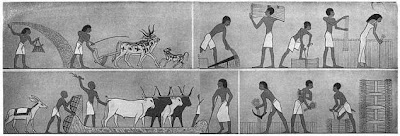
The linen for those summer clothes is made from flax of course. I didn't realize what a labor intensive process flax-to-linen is until I read about pulling, stacking, swingling, rippling, retting, scutching, heckling, spinning and weaving here. It's done mostly by machine now, but you can see Egyptians in these images growing and processing flax for linen. Do you suppose they ironed their linen garments? That would be an interesting frame added to these Egyptian collages.


We will be using another product made from flax when we install old fashioned linoleum squares in our bathroom. What appealed to us about linoleum (unlike vinyl) is that it is made from linseed - flax - and is natural and biodegradable.

Ingesting flax is good for you too. I take flax seed oil supplements for their high levels of lignans (chemicals that act as antioxidants) and Omega 3 fatty acids. There are wide-ranging health benefits against diabetes, heart disease, cancer and maybe Crohn's disease.


I was surprised to read about the "This Way" bike at boingboing. It's made from flax, but it looks like wood. I can just see myself riding this Big Wheel for adults on country roads to work. Nice thought actually.


I am humbled by new technologies as well as ancient processes that I know nothing about from experience. Friends like Gwen have sheered sheep and spun the fleece into wool, then knitted it into garments. She would not surprise me at all if she told me she has processed flax into linen.

Hands, hands, what are you doing? I think I live too much in my head.

Wednesday, March 04, 2009

Technology overload vs. the world in a cup

-
-

I've been trying to read books and printed articles as a balance to online surfing. The nagging voice to "read more books" (sometimes through friends in kind and subtle ways) is finally taking hold. The excuse that my eyes are too sleepy at the end of the day is getting ignored as long as it's before 8:30.

So it was great to find an interview with Nicholas Carr (author of Does IT Matter?) in The Sun (see Carr's blog and home page too), titled "Computing the Cost." It's about how the Internet is rewiring our brains. (The entire March 2009 issue of The Sun is about technology and its effects on us.) By the way, I read the print version.

Apparently we use different parts of our brains for reading a book or other print materials than for reading online. Carr refers to the book iBrain, by Gary Small who studied two dozen people, half of whom had little Internet experience, and half of whom had a lot. Dr. Small and his colleague scanned their brains while they searched the Internet, resulting in different patterns of brain activity. The subjects with little Internet experience showed activity in language, memory and visual centers, typical of someone reading. The experienced Internet users had more activity in the decision-making areas of the brain. Disturbingly, within a few days of surfing, the previously non-users' brain activity resembled that of the frequent users. I haven't read Small's book, but Carr questions whether we are losing a vital part of our brain function that thinks and synthesizes information.

While reading the interview, first off, I felt pretty good about myself for trudging through The Ambassadors week after week, because I have felt, decisively, that on p. 144 I am more easily grasping content than I did at p. 1 or 10 or even 80. It doesn't really bother me that it's taking so long to get through James' novel, because I'm getting through it. And I am finding it possible to sit for longer periods reading it too. Thirty minutes is longer than 15. And 60 is longer than 30. That's about what I'm up to, 30-60.

Second, I recognized that when it comes to information, more is not necessarily better. While access to oceans of information is great on one hand, on the other, a) it is overwhelming and b), as Carr says, we are becoming big flat pancakes with lots and lots of facts in our heads and at our fingertips, but losing deeper thinking skills. If I read a political story, then read four blogs about it, did I give myself a chance to reflect on the event? And what influence will government or other agencies use to control me one day, if I am too reliant on this medium?

Clearly, the Internet's value to become more informed about current affairs, geography, history, literature, the environment, ways to help and not least, meeting friends around the world, is vast. And by limiting information intake I don't mean I want to close my eyes to the world's problems.

I'd like to contain the world in a cup, which of course isn't possible. But I don't mind keeping my world smaller than the Internet and its Googles and Wikis want to pull me into. I think a deeper, more focused world is a richer one.


Saturday, October 25, 2008

first Collage-o-holic meeting

left: my mom; bottom: my brothers John and Bennett at the Acropolis; right: my grandma's illustration in World Book encyclopedia; middle: old books of my dad's and a French clock I bought Don in Paris

My name is Ruth, and I'm a collage-o-holic.

I'm a normal person, really. I never realized this could happen to me. I am learning not to be in denial about it. Please help me. That's why I'm here.

I was looking for a little fun. I had seen a nice collage at someone else's blog as a header, so I Googled collage software, and found Picasa's site. I've downloaded Picasa before, and got rid of it without realizing its seductive pleasures. I should have left well enough alone.

After downloading the free software, I made my first collage, the one on my header. I was pleased. And then my friends started telling me they liked it, and that made it even more fun.

I decided I could have a different collage header for each season. So I pulled in my favorite winter photos to start creating the next one. Five sample winter collages later, I began to think what other collages I could make. That's when I made this one, of old photos and things.

My arm and wrist are killing me from so much mouse clicking. My arm is about to fall off actually. Yet I go on. My husband doesn't recognize me without the glow of the laptop on my face. We eat American cheese sandwiches, un-grilled. My mind is ever filled with new combinations. I don't read, I don't care about who wins the election. I cancelled dinner with friends this evening to make collages.

Don and the roosters finally had an intervention with me. Bob the Crèvecœur rooster attacked me, and I kicked back, my clog flying and missing him completely. They made me come to this meeting.

(By the way, if anyone is interested, here is the 12 Step Program for making a collage:

  1. Download Picasa
  2. Let it load all the photos from your computer
  3. Organize photos into an album you want to draw from for the collage. Add more photos than you'll need since you have to play with them to see which look best together. I found it easier to organize an album into a file first in My Documents.
  4. Find that album in Picasa, which will show you thumbnails of all the photos on the right.
  5. Click on the little collage icon at the top to start a collage (next to Play - oh so exciting!). It will select all the photos in the album.
  6. Now, Select All at the top, highlighting all the photos.
  7. Click on Remove, sending the photos to the left side in a tab called "Clips."
  8. Now click on the "Settings" tab and see the various patterns, grid spacing, layouts, etc., choose what you wish. You can change this any time, so don't worry.
  9. Go back to "Clips" and start choosing photos and adding them to the work area on the right by clicking "Add." You can select and remove them any time.
  10. You can go back and adjust your settings any time, and shuffle the photos until the arrangement pleases you. You'll notice that it tends to crop the photos in unpleasing ways at times, so just re-shuffle.
  11. In "Settings" you can choose grid spacing, which creates borders around each photo, at whatever width you want, and you can choose any color you want! Wow!
  12. Play with it until you love it, then click on "Create Collage" in the lower left, and voila! You have a collage of your favorite photos.)

Friday, October 10, 2008

Barefoot College


photos from BBC photographic gallery and Barefoot College's web site

You might think a person has to be able to read to go to college. You might assume students need to understand the language of the teacher, or of fellow students, to succeed in school. You might envision that children who herd cattle by day would be too tired to learn how to build water pumps at night. You might just think that a woman who didn't finish primary school could not possibly become an engineer in six months, or teach someone else to become one, and you might be wrong.

When Don and I watched a piece about India's Barefoot College on the PBS Lehrer Report the other night, we sat dumbstruck. (Please, if you have 9 minutes, click on "a piece" in the previous sentence and watch the streaming video.) Maybe you've already heard about it. All notions about illiteracy and education are turned on their head in the 20 Barefoot College field centres around India started by Sanjit "Bunker" Roy.
-
Bunker Roy himself was born in what is now West Bengal and schooled at Doon School and St. Stephen's College in Delhi. He has won several awards for Barefoot College, including the Schwab (for social entrepeneurship) and the St. Andrew's Prize (Britain's largest prize for the environment).
-
photo of Bunker Roy, right, from Unesco site
-
He was influenced by Gandhi's philosophy of sustainable development. Roy said:
There is a mistaken belief that illiteracy is a barrier to the rural poor developing themselves with skills of their own. In other words a rural poor farmer, weaver, potter, leather worker, blacksmith and other artisans, because they have never been through a formal education system are not capable of producing high quality products with a marvelous eye for aesthetics and form. In the rural areas of India today, for instance, there are endless examples of rainwater harvesting structures for drinking water and sanitation still being used today that are hundreds of years old - constructed when there were no architects and engineers.

Bunker Roy started the first Barefoot College in Tilonia, Rajasthan, in 1972 after the 1966-67 famine killed thousands in Bihar state. Since then his colleges have trained villagers without paper qualifications to install and maintain solar electrical systems, hand pumps and tanks for drinking water. I could not believe my eyes as I watched village women work on intricate solar panels, taking meticulous detailed notes to study the codes and tiny parts, simply by watching their teacher do it and communicate with hand gestures.

Barefoot solar engineers have installed solar photovoltaic (SPV) home lighting systems and fabricated produced solar lanterns across 10 states of India. The results include:

  • Solar electrifying 870 schools across the country.
  • 3530 solar lanterns manufactured at the College.
  • 28 remote and inaccessible villages in Ladakh have 40 Kws of solar panels that provide three hours of light in the bleakest winter to 1530 families.
  • In Leh and Kargil districts, solar energy initiatives have saved a total of 97,000 litres of kerosene.
  • 392 rural youth including women trained as barefoot solar engineers with absolutely no aid from urban professionals.
  • 350 villages and hamlets(clusters) have been covered where a total number of 12000 households have been solar electrified.
  • 195,000 litres of kersoene saved, by replacing generators and oil lanterns with solar power.
  • All solar panels have been installed, maintained and repaired by the village people without the assistance of any paper qualified engineer.


The college has also instigated vibrant health care centers administering biochemic medicines (developed out of, but different from, homeopathy):


Since 1986, the Barefoot College has been using biochemic medicines. Many village men and women, most of whom have just a primary education, have been trained to administer biochemic medicines. This is fairly easy and does not need advanced academic qualifications. And since biochemic medicines have no side effects, these medicines are also quite safe.


in Tilonia, it is the children’s parliament, an elected body of girls and boys between 10 and 14 years of age that is responsible for making sure that schools are run properly—an ingenious way of giving children a hold on their own lives—and that of their villages.

Women have been empowered to participate in the local economy and infrastructure, and to lead other women.

Women are very active in the college. Here women gather in a village square to raise their voices in protest against cases of rape. Girls heavily outnumber boys in the night schools and many of the engineers trained in the college are women. One of the most successful solar lamps in use in villages in the area was designed by a woman using local material going to waste. Women have been going from village to village to gather support for developmental measures such as building local dams.


I am deeply impressed with Roy and his vision for helping people help themselves, including setting up rain water harvesting systems in many Indian villages. But I am flabergasted - and humbled - by the women, children and men themselves who learn and build the mechanics of these and solar electrical systems, and serve each other in order to strengthen themselves, their families, their communities - and the environment!

Sunday, March 30, 2008

opening up space


The little volume control on the taskbar at the bottom of my screen disappeared. I asked Peter on google-chat how to get it back, he suggested restarting, so I did. Nope, still gone. I don’t want to be going to Start → All Programs → Accessories → Entertainment → Volume Control every time I want to mute my sound.

Because Don was busy at school Friday night as Master of Ceremonies for “Family Fun Night” I was home with lots of free time. As I was browsing the various unknown programs array when you click “Start” next to the Microsoft logo, I found the “Disk Defragmenter” tool (although I doubt I could find it again). I thought, hey, good idea to defragment. That was about two hours ago, and it’s now at 42%.

What’s cool about this Disk Defragmenter is that it is moving files around that can happily be contiguous and save space. You can see the top row there before defragmentation. The bottom row is in process. All that white unused space is to the right now, and the contiguous blue is clustered together, using space more efficiently. It just needs some time to regroup and open up that empty space.

Defragmenting is what Inge and I talked about at lunch earlier Friday. Not about computers, but rather daily life. And we didn’t use that word, but it seems right now.

She was telling me how she had gotten sort of crusty (my word) with built up stuff (I won’t tell you what kind of stuff, since that’s her business if she wants to blog about it) and that she had spent some time putting her consciousness on it and “stalking” it. Then she found insights and connections in her readings that reaffirmed her life calling, and she felt renewed.

You gotta understand. Inge and I are pretty introspective. We’re perfect friends for each other.

This is the most stressful time of year in my job. Papers, records, mail, journals and books pile up, waiting for less busy days to read, sort and file them. Students get annoying, colleagues get annoying, the University gets annoying. I can let resentments build up.

Friday morning my friend Alek in Greece posted this great black and white photo of an old Athens restaurant with a huge window and high ceiling. Something about that high-ceilinged room ~ head space ~ reminds me of defragmenting. You’re out on the busy streets of Athens, you stop shopping and bumping into people and step into this cool space and drink a café. All that chaos from the street hovers invisibly above your head. Your solitary self settles and regroups.

It’s fairly easy to see the need to declutter my house - throw laundry in the hamper, clear off the counters and put the dishes in the dishwasher, pick the newspapers up off the floor. It’s not as easy to see when my computer files need to be reorganized. It’s even less easy to see when I need to defragment and open up some space in my own head, free of crapola and annoyances that like to add up. And I guess my point is that it’s probably more important to do it when I am stressed and busy than when I’m not.

Hey! The Defragmenting is done. The report says:

0 files fragmented (I guess it didn’t need defragmenting after all.)
I have 8,236 folders (all those photos).
I have 36% free space.


Monday, March 03, 2008

phone

~

Alexander Graham Bell’s birthday is today, Monday, March 3, b. 1847, the same year as my grandpa! (Yes, my father’s father was born in 1847. In fact, he fought in the American Civil War - on the losing side. I am two generations removed from the Civil War, and I’m only 51. My dad’s dad was 70 when my dad was born. He died when my dad was 9. And my dad was 40 when I was born.)

On March 10, 1876, Alexander Graham Bell spoke the first words into a telephone:

"Mr. Watson -- come here -- I want to see you."

Wiki says he (Bell - not my dad, or my grandpa) refused to have a telephone in his study, because it intruded on his true work in science. The inventor of the telephone said it was an intrusion and didn’t have one in his office. Hellooooo!
-


We have gotten rid of a land line in our house (it was an intrusion), but we each have a cell phone. This model put out for Verizon customers is pretty low tech now compared to state of the art models, like the next one, below it, with a slide-out keyboard. But we always get the cheapest model. Yeah, my charger connector is broken, so we have to charge Don’s and switch batteries every few days. Jeepers.


I mostly talk with my kids and Don on my cell. (Why don’t we call it a mobile like the rest of the world? Same reason we don’t buy into the metric system? We’re stupid?) What did we do before cell phones, picking someone up at the airport? It’s fun to send text messages and pictures too. It’s great having all my Contacts on speed dial. Owee, Boots has two numbers, one’s her cell, and one’s her land line.


This picture on mine was one Don took of one of his sunflowers. I love it when Lesley pix messages a pic of herself at Central Park or in front of the Empire State Building. Or just smiling at work. Ah, two flowers.


-
-
-
Speaking of NYC, I’ll never forget September 11, 2001. Well of course. But I mean that at noon that day, I was supposed to meet my friend for lunch. After what happened that morning, we decided to cancel our plans. But then I wanted to be with other people. So I walked across campus anyway, to the International Center, and there was my lunch friend watching CNN on the ceiling mounted TV in the lobby, along with a hundred other people.

In that 10 minute walk, everywhere I turned, crouching under trees, walking slowly on sidewalks, sitting on building steps, every single student was on a cell phone. It was eerie, knowing what everyone was talking about, even though I couldn’t hear the words. They were saying the same thing I was saying to my kids and to Don on my cell: "Are you there? Come here -- I want to see you."

Tuesday, September 25, 2007

WWYD?


What would you do?


We saw this little electric car (the Volt) at the Detroit auto show in January, and of course it was my favorite. I dragged Don out into the frigid cold to downtown Detroit because I wanted to see cars with alternative fuel sources, I thought it would be a big year for cars like this in the news. (And I had the East Lansing Daily Photo blog to keep going.)


Well this little guy is one of the reasons the GM United Auto Workers union has gone on national strike for the first time in 37 years: They want GM to build this car in the US, not in Asia. They want job security: 73,000 workers nationally, over 5,000 locally here around Lansing.

So many issues! I've been supporting foreign cars for years because the quality is better. (However I currently drive a Chevy Aveo.) But I don't want 73,000 American workers out of work. I have to see "Who Killed the Electric Car?" and get angrier at the auto company executives for killing the technology of this alternative car energy in the 1970s.

Yes, auto execs at GM asked that their salary be halved earlier this year to help the struggling auto company (or at least to help how they look). Only $2.5 million for the CEO Rick Wagoner, not $5 million. And no bonuses this year. But their compensation packages still doubled! (Stocks, etc.)

Even auto workers are finally disgusted with auto execs and the choices they've made in the past few decades. Detroit could have been, should have been, the leader in alternative fuel-burning car development! Detroit could have been Paris by now. This could have been the Riviera. But no, they let Japan take the lead in developing hybrid cars. Our execs were greedy for the high price tags and profits of SUVs. Don't misunderstand me, I want all countries, all economies to do well. I'm not waving the American flag for dominance, believe me. I just want this powerful country of ours to take a lead IN THE RIGHT THINGS.
-
This also raises the question of unions. We recently watched the folksinger Woody Guthrie's story in the film "Bound for Glory" which is also about the start of unions in the US. Back in the 1930s, unions were an important way for poor workers to obtain and maintain their rights. Wiki has a history of the United Auto Workers. And here is a UAW timeline.

But what do unions do for many of us now? I don't belong to a union, but Don does. But because his is for public school employees, it's against the law to strike. So what power do they have for the $800 per annum they pay per person? And auto plant workers make $26 an hour now. How times have changed.

So many questions, so little time.

Anyway, if you were the CEO of GM, what would you do?

Saturday, June 23, 2007

Today in 1868 the typewriter was patented

I learned to type in high school in typing class on a manual typewriter. I got pretty fast: 75 words a minute. It wasn’t easy to type all the keys with consistent pressure so they all looked the same. There were no letters on my keys, which forced me to memorize them.

My parents gave me a Brother typewriter for high school graduation in 1974, which I used for typing all my papers in college the next three years. Back then we had to use something like Wite-out to correct mistakes. It was a pain in the butté to put footnotes at the bottom of the page, let me tell you.

Later, when I worked as a secretary, IBM Selectric typewriters were on the scene, with a backspace key that pulled mistakes right off the page. What a lifesaver. I got so fast on those typewriters I would get ahead 0f its capabilities and it would freeze for a second, making me slow down. Man, too bad I didn’t use this agility to develop my piano playing skills.

In 1991, when Don went back to school to finish his teaching degree, we bought our first personal computer, a used Apple 2C – 6” floppy discs and all -- from his brother. With word processing, we could write, rewrite, move words, paragraphs, delete with a highlight and a button. We bought a new home computer every few years as old ones became obsolete.

Last year I got my first laptop, using a money gift I received just for writing a special report for a study abroad program. (That’s when I got my Olympus camera too. Pretty nice gift.) I use my laptop for work and personal use, and I have a desk “port” in my office for easy and quick clipping in and out. I take it home with me most evenings since our home computer got zapped by a thunderstorm last year. We just have dialup at home, bummer.


my office desktop

Before all this technology, I remember seeing dip pens in my father’s desk growing up, the kind with removable nibs, for dipping in an inkwell. My favorite author, Jane Austen, used these. The fountain pen wasn’t invented until the 1850s. If you’re into calligraphy (Ginnie, rauf), check out this in depth page about flex nibs. With carpal tunnel, I can hardly write a thank you note these days, let alone do calligraphy. My sister Boots (aka Ginnie) has beautiful handwriting. It could be its own font style.


I write poems on my laptop. I love starting with that fresh white empty page. Hit “enter” four times to start the first line (the title usually comes later) in Times Roman size 12. Stroke a key and type the first words. My friend Inge loves to write poems in longhand. It’s a beautiful mind-to-hand process, more organic. But me, I love typing on the computer. Sometimes I retype four lines 20 times. Imagine the paper I would waste if I wrote it out!

Out of curiosity, I’d like to know if you:

~ write hand written letters any more?


~ If you write poems, do you like to write them in longhand or on the computer (or on a typewriter)?


~ What’s your favorite pen or pencil? I like rolling ball pens, especially Pilot Precise or Uni-ball.


~ When you post a blog, do you type the text out in a word processing program first?

~ What's your favorite font? At work I use "Comic Sans MS" size 10 in most emails and other documents. When writing poems I use Times Roman size 12.