alskuefhaih
asoiefh
Showing posts with label nature. Show all posts

Monday, June 04, 2012

First outdoor blessings with my grandson, 4 months old


1
I have never been a farmer, or farmer’s wife, sweating
fruit lost to hard frost, and livelihood, or praying for rain.
I have never wanted to. (Will you?) We play here.
Our fingers are smooth. But we grieve
our lost plums so soon come. And we will feel
the cold stone in the barn
on a scorching day, and sigh.

2
I have been trying to tell you
about the fanned gusts from hummingbirds.
Look out!
for their ferocious beauty.

3
Are you as warm as I am?
Perfectly?

4
Just between us, we know the
cool cave of solitude
of the mouth
and when to open it.

5
Do you think the bee
was confused when the sage
bloomed plum petals
that look like iris
through needles of rosemary?

6
I wonder when you will first feel
that the road
your tongue takes
out of your own heart’s gate
is one of loneliness?
This is a mixed up place.
For now, join all these birds singing together.

7
Hear the poplars?
They are saying a dappled hello from
Courbet, Sisley and van Gogh.
(See, it isn't always lonely.)

8
This air is a bridge
between us
and all.
All!

9
Creation is what you make
of what you are given
and also
what you are not.
The path in the woods,
and what it passes through.

10
Please feel all this emptiness.
It is absolutely necessary.
May what you give back to it
always be as true
as the small clear stars
of your voice today.


June 2012

It is a hobby farm we live on. We have absolutely not a single apple on our three apple trees, or a single pear on our pear, or plum on our plum. But it is the fruit farmers in Michigan this season I really feel for. The heat in March brought out early blossoms on the trees, and then a hard killing frost in April annihilated the fruit. Pretty much the entire cherry crop has been destroyed, and Michigan is the source of 80% of the world's tart cherries, so you can imagine the impact this has on our state's already wobbly economy. I posted about cherries up North three years ago here.

Here is a minute and a half of video and audio accompaniment out of James's first real outing a couple of weeks ago. I was very moved by the undulations of his tongue, showing that he was meeting nature with it as much as with his ears, eyes and skin. You will hear a small interruption of James's grandpa laughing, then asking me "Where'd Brian go?" and me, grammy, answering, "talkin' to his mom" and you'll see James's grandpa watering his garden. The way James kept gurgling outside when I introduced him to the trees on a walk later made me feel he is simpatico about nature.


-
-

Tuesday, May 22, 2012

After reading Frank O'Hara

-
-


Frank O'Hara's perspective is profoundly urban, and I love his leaps and dives. The poem I read before my foray in the garden was not this one, a favorite, and with rare observations of nature. But it ended up inspiring mine. I don't know how he does it, just what he describes, to deepen you with his quickness. He catches that sense we get from a poem when you simultaneously feel you've discovered the deepest truth for the first time, but that you also knew it all along.

POETRY
by Frank O'Hara

The only way to be quiet
is to be quick, so I scare
you clumsily, or surprise
you with a stab. A praying
mantis knows time more
intimately than I and is
more casual. Crickets use
time for accompaniment to
innocent fidgeting. A zebra
races counterclockwise.
All this I desire. To
deepen you by my quickness
and delight as if you
were logical and proven,
but still be quiet as if
I were used to you; as if
you would never leave me
and were the inexorable
product of my own time.

I actually wrote my poem below after reading another O'Hara poem, "Meditations in an Emergency" with the lines:
However, I have never clogged myself with the praises of pastoral life, nor with nostalgia for an innocent past of perverted acts in pastures. No. One need never leave the confines of New York to get all the greenery one wishes—I can’t even enjoy a blade of grass unless I know there’s a subway handy, or a record store or some other sign that people do not totally regret life.

After reading Frank O’Hara

I am weeding
the bed of mint—
spearmint peppermint
chocolate —
and feel the quick stab
of stinging nettles
through garden gloves

the damn leaves
almost the same
and while I rub
the tender spot
you tell me
it is good
for pain

No kidding, I think

But what you mean
is that its extract
relieves pain
in joints and such

and so I squat back
down in the delicious air
and let the pain
surprise my hands
with goodness
before
they feel it


May 2012

-
-

Friday, May 11, 2012

Moose

-
-

This poem is an attempt at plagiarism. I come from poetry lessons with Robert Kelly and Diane Wakoski who taught that copying the poems of others was something like what the copyists at the Louvre did who learned from the masters. But in writing a poem, perhaps unlike painting, even when you try to copy another poet your own voice is bound to come out and no one might be the wiser as to what the original inspiration was. In an interesting project Robert Kelly wrote “into” Percy Bysshe Shelley’s “Mont Blanc,” adding his own text, thereby creating a new poem in book form, also called Mont Blanc. Diane Wakoski taught that if you take a poem and change the words to be your own, you are creating something completely new.

The past couple of mornings I’ve read and reread a poem by Native American poet Joy Harjo called “Eagle Poem,” which was the Writers Almanac entry for May 9. I was swept up in it, soothed, transported. Then I remembered a morning like hers when I hiked the Pacific Crest Trail in Oregon the autumn of 1976, the semester I lived up the mountain from Ashland with twenty-two students and six professors studying philosophy, literature, science and nature. One morning of the five mornings on the trail, I met a moose, an animal whose size can only be imagined, until you stand within a few feet of him.

Here’s my poem, a “plagiarism” perhaps of Harjo’s “Eagle Poem,” which I’ve included below mine. Of course plagiarism is not acceptable in prose. Is it in poetry? In this case, I am not stealing imagery or word combinations; I’m stealing the poet's pose as prompt. Maybe it is simply imitation, a form of flattery and praise for Joy Harjo.

Moose

To forage in a dark forest alone,
nudging underneath all that has dried
for a bit of life, for what keeps you going
another day. To believe you will find it
in a green leaf tipped up and up
by a breeze, or in tufts of grass
as fresh in your mouth as water.
To trek on into the black and brown
for more, always more,
trusting there will be enough green
to fill your huge being. Like the moose
at Moss Springs standing broadside
when as a college co-ed I lumbered
around the bend a mile ahead
of the trekking pack, mindlessly
lost in myself, our distance
less than his height. In his eyes
such questions, not of justice
or ethics, but of balance.
We each stood our ground
watching the other. How long?

This long. Still. As long as it takes
I know that it was on that woody hill
my clumsy shyness grew less; alone
with another I found patience to watch.
And suddenly the forest crashed
into awakeness when the bull ran off,
impossible barrel on table-legs, his crown
tipping up and up, like oak leaves.


May 2012


Eagle Poem
by Joy Harjo

To pray you open your whole self
To sky, to earth, to sun, to moon
To one whole voice that is you.
And know there is more
That you can't see, can't hear
Can't know except in moments
Steadily growing, and in languages
That aren't always sound but other
Circles of motion.
Like eagle that Sunday morning
Over Salt River. Circled in blue sky
In wind, swept our hearts clean
With sacred wings.
We see you, see ourselves and know
That we must take the utmost care
And kindness in all things.
Breathe in, knowing we are made of
All this, and breathe, knowing
We are truly blessed because we
Were born, and die soon, within a
True circle of motion,
Like eagle rounding out the morning
Inside us.
We pray that it will be done
In beauty.
In beauty.


"Eagle Poem" by Joy Harjo, from In Mad Love and War. © Wesleyan University Press, 1990.

Photo of Mount Hood Wilderness near Ramona Falls from Wikipedia Commons
-
-

Wednesday, April 18, 2012

Dancing at dawn

-
-


Dancing at dawn

I sit alone, like a pocketed wheel snail
snugged in sandy dawn, the sun
angling for salmon behind the barn’s thistle weeds;
off to the side the sky is the color of shallow tide
around the moon soon to be a filament
of film clipped on daylight’s floor.
The birds sing all at once and more, without
bounds and oversound the shells
of my ears with sea.
I bob and skim my chest at the edge
of the hot tub, the way seahorses slowly rock
intoxicated with love on YouTube
for us who only swim among the kind
of coral that grows neon in the sky.


April 2012

Poetry should be heard.


And a less "produced" version, after a few helpful comments...

-
-

Tuesday, April 03, 2012

Resurrection

-
-


Resurrection pulses through me like a river
pushing aside moments of death. My foot steps
ahead toward the Russian olive, solitary, about
to bloom in the meadow, fresh-mown for summer.

But for now it is spring, the season of risings.
What good are prayers for the already dead? Where
does that love go? I see the raccoon’s den-hole
beside the grass-covered log long fallen,

its dark opening only he can trust. I hear
the watery throat of a cowbird and know it
as the same stream, already across the pasture
where I follow. I watch her fly away, and disappear.


April 2012
-
-

Wednesday, March 28, 2012

Poem: The Soul's Correspondence

-
-


The Soul’s Correspondence


Freely, the black locusts bend and wave
from limbs and fingers, waterfall
spray across their stone slab of sky.
The older the tree, and taller,
the greater the grace. The young
birch and plum imitate with curtsies
in their small way, new to the wind.
The spruce’s scraggles heave and flutter.
Bamboo hisses; leafless poplar echoes.
They write poems with ease,
roots deepening below them in the earth.
Not buried exactly. But weighted,
spindling toward magnetic center.
Listen birds, stop squawking at me.
I want to hear the Soul’s correspondence
through the spirits of trees, while I rest
hands in my lap. No writing. No work.
Up from the essence of survival. No,
listen. It is far more than that.


March 2012
-
-

Tuesday, March 13, 2012

Sap at night

-
-


Sap at night

Before budding begins,
the last pure stream of the maple
drops into the bucket-moon
sweet and uncluttered


Postscript note: Because of early warm temperatures, Don has been harvesting sap from eight buckets on four six maple trees since early February. Normally he would not begin tapping until late February. Sap is sweet until buds begin to form, then it becomes bitter and can't be used. We have noticed buds starting to sprout on all the trees and shrubs, and with the expectation of very warm weather this week (70°F, 20°C), he only has a few days of sap left to carry in. It takes 40 gallons of sap to boil into one gallon of sweet, buttery maple syrup. So far, he has boiled about that much, with another fourth of that to go. Depending on conditions, some days a five-gallon bucket is full in just one day's sap run.


-
-

Friday, February 10, 2012

On becoming a doe

-
-

What is it you feel on a walk in the woods when you know that suddenly you must stop, because the energy within you and surrounding you has become one? The white pines you love, from the tops of their sky-touching branches to the needled floor coppery and aching to be slept on, are full of deer-ness, though there is not one in sight. And, as though magically transposed into a doe yourself, at last you commence your walk, changed. Yet, as a deer, though you might have assumed before now that you would be fearful as one, you are not afraid; rather, you are attentive, listening, stepping foremost with your nose, black and moist, your ears and hide the color of the pine needles, together ruffling in the breeze.

And from where did it come, this deer-ness, and what does it matter, when next day on the next walk you remember that you are now a doe and instantly you hear a rustle by the pond, not thirty feet away. There, six does eat leaves of the poplar saplings and stop for you. O the moments when this transpires, the eternal moments when everything is one. They recognize you now. They have met you here for breakfast. They felt you within and without, walking in the air, eager to join them by the frozen pond table. They know that you are no longer separate. Yet it is their nature to bound off at last and leave you, alone, aware that you were the one who had this to learn.
-
-

Wednesday, January 25, 2012

poem: little tree

-
-

little tree
for my newborn grandson, James

(I cannot speak this directly to him.
It must be in the second person.
What would happen if I told him what is here?

I am not ready to break anything
that is not yet broken open.
The world has just begun.)

His head is in my hands, mouth open,
eyes half-stupored. He is breathing me,
as if I am winter, to warm in his mouth.
He exhales me back to me.
My voice is a silver blue bead he fingers
with a perfect tongue.

He has not learned to forget
that the earth always has her mouth open,
holding the sea and not swallowing,
nesting the trees for their nesting birds,
breathing the sky and not throwing anything away.


January 2012

Poetry should be heard. Perhaps listen to me read while playing a song for Egon Schiele, below.

Painting "Little Tree (Chestnut Tree at Lake Constance)" by Egon Schiele

Listen to Rachel's song Egon & Gertie. . . .

02.egon & gertie by Rachel's on Grooveshark

-
-

Thursday, January 12, 2012

Poem: Free

 -
-

free

In the mist
around the rising sun
a bird

also rises. The wood fire
clicks in the iron box.

Are the bird,
the sun,
and the fire
confined at all?

Or do they simply
move their breath
freely
for interpretation
within the medium
of each other’s worlds?


January 2012


Painting "Mist" by Nicholas Roerich
-
-

Wednesday, October 05, 2011

Poem: Red Pines

-
-

Red Pines

Every day I drive to work
and it is the same thing. Listen
to two minutes of political news
or economic disaster. Turn it off. Sail
past farmlands with birds.
Sit at my desk, answer, type, question.
Drive home between the same
houses for sale. Work to Friday.

On Saturday the sun shines down
on the oasis of meadow and I get up
to walk the still-wet grass into the end
of summer. Sunflowers fall away
from the sun, petal-stripped but big
bellies of seeds still feeding the traffic
of chickadees. Goldenrod and Canada
thistle sputter in ragged frizzles out of
dirty brown stems; royal pokeberries
droop down down down like antique
necklaces from the necks of dowagers.

Long they stood, these thin strong
spines, day in and out. Would I
complain in their constant stillness,
rejoice in the skyslide of a storm?
So slow ! this meadow watching, and yet
too rushed the machinery of what I live.
Now they fall headlong, tassels touching
each other over the path, weaving a baldachin
over half-moons of egg-yolk mushrooms.
Orbs of green walnuts revolve around them
in planetary randomness.

Rain on my glasses blurs sight:
My favorite red pines in a long row glowing
and backlit — Are needles dying among
the soft green plumage? Tenderly I pull
a cluster, and without resistance they release
and fall into my palm, spent. Some blight
is taking the trees. O Beauty, where to?
I am always at the edge, this side of that. A fly
flies in and out, drawn to some heat
in me, or scent: the other. I am apart, skin
side out, embarking or disembarking
onto the path whose current pulls me
into the fields like kindness.

What honeyed dark energy sings
from the yellow soybeans in the field
next door as the beans dry brown, harvestable,
the green leaves going going almost gone?
Can the farmer, scientist
or economic analyst answer:
No matter the speed of matter,
no matter where we are falling,
what makes the heart keep accelerating?


Poetry should be heard.


-
-

Friday, September 30, 2011

Poem: Solitary tree

-
-


Solitary tree

Do you feel yourself
standing on the platform of the earth
served up as if for my pleasure alone?

Alone, yet not lonely,
happy in the sunrise, or shining
in sheets of rain, you wait again
for the warbler to sing.

Patiently, you hold her
in your quiet branches,
where she sits or flits, free
in an improvisation of notes
high and low, never touched
twice the same.


Poetry should be heard.
-
-

Tuesday, September 27, 2011

Poem: What and where I was a few nights ago

-
-

What and where I was a few nights ago

I wasn't a star.
Not a rain cloud.
Or a rose.
I was not the barn, or a bird flying out its chink.
The reflected sky-silk on the pavement
was thicker than a hundred of me—
not even an opal fingernail.
A pile of mountains
on a weave of snowmelt
in an ocean of red planets
brushed across the eyelid of air
like a fox
and twitched its tail.
I was a minute that couldn’t.
I couldn't touch the bud at the tip
of next spring’s twig-tongue.

I was no thing. No word. No body.
The air said: We are invisible.

And then there was
no where we weren't.

Poetry should be heard.


-
-

Monday, September 26, 2011

Poem: A year in an apple

-
-


A year in an apple


Crunch into the sweet flesh,
and winter snow crumbles under a black branch
where the juncko lands.

With the second bite, the entire orchard
blossoms pink again in your mouth.

Hold its red skin against your cheek
and it is a hot summer day
but you are cool in the shade
of the tree it fell from.

It is autumn, you are eating an apple.
For a few moments remember the year,
how it opened and fell into a thousand pieces
and how you widened your being.


-
-

Tuesday, September 20, 2011

Poem: At the orchard

-
-


At the orchard

It is a late Saturday afternoon in early
October, and I am headed nowhere,
certainly not the cider-and-doughnut orchard
I happen upon, where it seems as though
the Rapture has air-lifted the good farmer
and his customers up into a mountainous range
of clouds, leaving behind this littered
grassy harbor at the side of the road.
I stop the car of course
and stroll and meander among abandoned
crates and bushel baskets domed
with butternut squash and apples, the way
I might wander a marina eyeing steepled yachts
with prettily altared bouquets and exposed living
rooms of the heavenly high life, as frivolous
as these pumpkins lounging in the field, perfectly
tufted and plush in rafty orangeness,
waiting to be the chosen, to pose as ghouls
or toothy goofs, thick, rich flesh and eyes
golden candlelit within. And over under a tree,
a grubby discard of apples on the ground, unhinged
and white where broken, fading to gray ferment
at the bruises where a fleet of yellowjackets fizzes
out the only sound, in full-out bingeing, mindlessly
enraptured, partying like there’s no tomorrow
                                                   or this or that life.


-
-

Thursday, September 15, 2011

S.O.S.

-
-


Through the window this morning, flickering behind poplar leaves, the sun rose. Was it S.O.S. he coded? I was on the phone, but I wanted to end it, someone else was calling. What if I, and only I, were the last hope of the sun, losing his way? Now tonight, three flaming candle wicks in glass duck and bob in the corner of this dimly lit bathtub like ladies urgently gossiping around a red tablecloth. I can almost hear them lisping. Yellow heads beat toward each other, but not toward me, and too rapidly and quietly to be comprehended while I am submerged, steamed and exhausted into stillness—eyes fixed on them and nearly hypnotized into sleep. I am an outsider, the last to know, and then, slow to respond. Is it urgency when poplar leaves twist and flutter like drowning hands? Or are they not drowning, but waving? Earthy sheaves of leaf and flesh lace over what burns and glows. Even just atmosphere alone flips the flame into frenzy. Glimpsing, we see some truth of it. But the light is still, in itself, and does not need rescuing.


-
-

Wednesday, September 14, 2011

synchronizing art & fashion continued: New York Fashion Week Spring 2012

-

I painted and designed clothes for fun when I was young. I should have done more with it. Maybe it’s not too late. One way I get my fill of art and fashion now is during the fashion shows when I challenge myself with a visual matching game between pieces of art and new clothes designs. I become a junky looking for color and pattern every day at Fashionologie to see when the next designer’s photos get loaded, and then I go scour online art galleries for matches. It’s creative hedonism. I ignore the news. I forget about poetry. It’s also creative masochism, as my right arm, shoulder and wrist ache with mouse overuse.

My arm will recover, and the somber and complex tapestries of the world will go on being spun without me paying attention for a week. Poems will keep. (But the pears wouldn’t, so Don and I canned six quarts of them after we got home from work last night; bruises and soft spots were spreading.) Of course I was also with our son Peter in spirit through his scary accident when our world did stand still. Thank you for your caring wishes, he is on his way to recovery after reconstructive surgery Monday.

Truly, I look forward to these creations as much as I look forward to morel mushrooms sprouting overnight after April rains when we practically crawl through the woods by the pond and the fallen apple tree scouting for their weirdly beautiful brainy patterns.

I am especially excited by one pairing today. You'll see why in a minute.


: :   : :   : :


Sometimes a girl just really gets lucky. I don't know how Zac Posen could have designed a suit to look any more Picasso-esque. That peplum on Posen's jacket: serious cubistic hips! Zac Posen, a Manhattanite, first began designing clothes as a boy when he stole yarmulkes from his grandparents' synagogue to make ball dresses for dolls. If you're into clothes like Zac, browse his entire collection of ball gowns, it's simply gorgeous.

Don't you wonder what's happening in this painting?

-
 "Interior with a girl drawing" by Pablo Picasso

 Zac Posen suit with Picasso Peplum


: :   : :   : :


More cubism from Carolina Herrera. Every season this woman's designs knock me out with simple elegance, and this spring collection she does it again. There are actually many cubist paintings of gray that this dress reminded me of, by Braque and Picasso. I settled on Juan Gris.


Painting by Juan Gris


: :   : :   : :


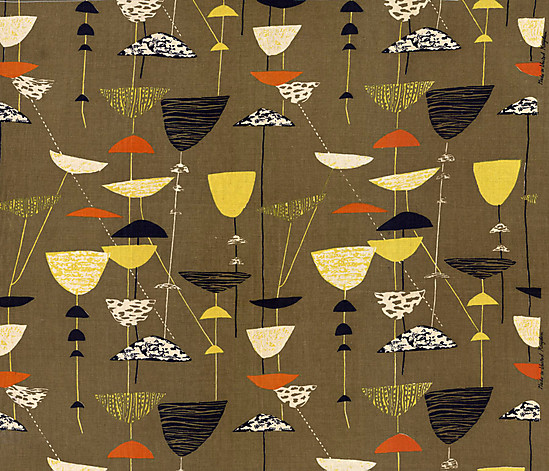
Another designer who never fails to satisfy with her confident sense of design and beauty is Donna Karan. She manages to be playful with pattern without being silly. Some of her fabulous collection had pattern, like this, which instantly reminded me of this textile by Lucienne Day, though I had a time finding it, since I didn't know the artist's name. Now that I do, I have learned that Lucienne Day (who just died last year) was a British textile designer who was inspired by abstract art by the likes of Joan Miró, Wassily Kandinsky and Paul Klee. Hellooo! After the print pairing, see the graphic browns and blacks Donna Karan designed, which reminded me of Paul Klee's painting "Intention."


Lucienne Day's textile "Calyx"


"Intention" by Paul Klee


: :   : :   : :


Now here are my favorite pairings. My charming friend George is one of those people who does many things very well. He ponders, writes, travels, walks, paints, photographs and blogs with utter grace and beauty. If you are not yet familiar with his posts at Transit Notes, you are in for a treat for the eyes, mind and spirit. On his sidebar, George has posted a few of his stunning abstract paintings, and it suddenly occurred to me in my last fashion post a few days ago that I might be able to match his paintings with fashion this season. Although I'd hoped to match clothes with more paintings of George's than one (I'll keep looking), I confess I didn't expect to find anything this well matched, by two different designers: Timo Weiland and Peter Som. "Subterranean" is among my favorites of George's work, partly because it represents an invisible world where life swarms and vibrates, like the inner realms we discuss at his blog, the Rilke blog, and elsewhere.


 "Subterranean" by George McHenry of Transit Notes

Peter Som dress

Suit by Peter Som


: :   : :   : :


Consider the lilies how they grow: they toil not, they spin not; 
and yet I say unto you, that Solomon in all his glory was not arrayed like one of these.

~ Luke 12:27


And now for the local show room. These simple jewels around the farm are beautiful in color, form and pattern. Any designer would be envious, and I imagine that songwriter Solomon himself would compare them with his beloved . . . 

My beloved is unto me as a cluster of pokeberries . . .


As the goldenrod in the field glows like the sun, so my beloved's love is to me . . .


My beloved's lips are the color of the sumac blossom, and as soft . . .


You have stunned my eyes, my beloved, with even one of your lips,
red like the sumac leaf . . .


I have come to your garden, my beloved, and gathered your peppers, as colorful as the jewels of my temple, as sweet as flowers and as fiery as the days of our youth . . .


All fashion photos from Fashionologie.
-
-

Tuesday, September 06, 2011

Poem: Wild

-
-


Wild

Wild, the sky says “dance”
and the clouds obey.

My hands are birds, posing
in the trees, accompanying.


 -
-

Friday, September 02, 2011

"Season of mists and mellow fruitfulness"

-
-

Nights start to cool, tomatoes like the world grow heavy. A mid-size calf looks at you and splays to his mother. She lows protectively, and in that moment looking into her eyes, you see that together you are pilgrims under an isinglass sun, though she is wary of a traveler such as you.

Title from John Keats' ode "To Autumn"
-
-

Wednesday, August 24, 2011

Poem: Little stints

-
-


Little stints

Under white cloud mountains as stiff as meringue
the shore pulled away, me in a daze
of life. The windowed, curving mansion on the dune
emptied itself onto the air.

Two little stints ran and stopped, ran
and stopped, in the thin shine at the water’s edge,
their bills the gauge of what is well,
what is continuous, their black feet whirring
in the same motion of the paddleboat
thumping by with tourists,
whose wind-distant voices tipped
the horizon like sails flitting
in a sudden, subtle flap.
The sandpipers must have found
their bugs, or maybe tiny shelled
beings that I take for quartz.
Ahead of me they darted, then bowed
in a moment’s snowy bite, and again
the quick black feet motored along.

I felt blind
to everything but feeling, a human without
the sense of a beast, loping into nothing,
out of nothing, chasing shore birds
in a slow wade, my legs an ache
of sand-walking, my body fresh but tired
from swimming, where something had washed
away, and something had returned,
though I could not say what it was.

Of a sudden, they flew up and arced
behind me, to where we had already walked,
to the somethings I had not seen, the things
I had forced them to pass over too quickly,
but in all their lightness, they knew
awaited them in their brief and patient life.


Listen to a podcast of this poem here.

Photo credit: Wikimedia Commons
Photographer: Andreas Trepte, more beautiful bird photos
-
-