alskuefhaih
asoiefh
Showing posts with label art and design. Show all posts

Friday, June 22, 2012

June bug

-
-
Diane Wakoski preparing to read poetry at The Scarab Club


In Michigan in June we see lots of June beetles banging against lighted window screens and we also see them dead on the sidewalk like pieces of broken brown bottles.

I went inside one very alive beetle this week. Once a golden scarab that could have been the Paris of the Midwest, Detroit is of course now littered with crumbling empty buildings and brownfields, photographed and even relished the world over for its "urban decay porn." But there are jewels in the city that are protected and showcased by loving enthusiasts. James and Kim hosted a poetry reading Wednesday by Diane Wakoski in the heart of Detroit's Cultural Center at The Scarab Club, across from the Detroit Institute of Arts, where Diego Rivera's famous Detroit Industry murals glow. When I walked into the club with Diane, Robert and Heather the space lit by the towering garden window opened me up like a beetle flying to light. Paintings by students from the art school Lesley attended backdropped Diane's reading of her poems about movies.

Afterward some of us had dinner at the Union Street Cafe on Woodward Ave. Listening to James and Kim talk about the club I realized once again how little I know about the Detroit scene. It is alive thanks to the people who believe in its heart and culture.

Here is a poem by Diane that conjures elements of summer and Detroit for me. I have these episodes of inspiration to get inside Detroit. And then I get distracted by my university and country life a couple of hours away.


Inside Out
By Diane Wakoski 
I walk the purple carpet into your eye
carrying the silver butter server
but a truck rumbles by,
                      leaving its black tire prints on my foot
and old images          the sound of banging screen doors on hot
             afternoons and a fly buzzing over the Kool-Aid spilled on
             the sink
flicker, as reflections on the metal surface.
Come in, you said,
inside your paintings, inside the blood factory, inside the
old songs that line your hands, inside
eyes that change like a snowflake every second,
inside spinach leaves holding that one piece of gravel,
inside the whiskers of a cat,
inside your old hat, and most of all inside your mouth where you
grind the pigments with your teeth, painting
with a broken bottle on the floor, and painting
with an ostrich feather on the moon that rolls out of my mouth.
You cannot let me walk inside you too long inside
the veins where my small feet touch
bottom.
You must reach inside and pull me
like a silver bullet
from your arm.
-


Thursday, May 03, 2012

Bonfirebird

 -
-


Bonfirebird


We circle ‘round
a bonfire at midnight.
The fire is warm, and dangerous.
We can’t turn our faces
away from its seductions
yet only get so close.

Next gray morning it feels safe
to poke the nest of ash and char
with a cold black stick,
looking for the truth of fire
in what is left behind.

But, O Soul, don’t hide
your face and wait like that; turn
over the crimson ember-eggs
of desire buried in ash; pile on
dried spikenard and fig,
almond and cherry; smell
as they crackle to life; feel
how voluptuously
your flame-wings rise up!


May 2012


Art notes
Top: Costume Design for The Firebird, by Leon Bakst
Bottom: Cover of the book The Firebird, by Konstantin Somov
-
-

Friday, April 20, 2012

Letters from home

-
-


Maybe it's because of National Poetry Month that I've been reflecting a lot on why I write poems. This blog has changed dramatically since I began in 2006, and these last couple of years it has become almost exclusively a poetry blog. I never intended it! It's just how things want to come out, a sort of shyness, not wanting to say things directly. I don't apologize, but I do realize poetry isn't for everyone. Funny, this write began as prose. I had every intention of writing prose! But it shaped itself into a poem. What is a person to do when a poem asserts itself?


Letters from home

That’s what poems are.
We are migrants from
somewhere that loves us.
Poems come from there.
News of a death,
news of a birth, both
in one letter. We want only
the truth, and nothing
held back. Things that
have come to pass,
and dreams held fast.
Read them again;
read them over again,
softened with time
in the shifting dust
of this foreign place.

April 2012


Note: The painting is Saudade by Brazilian painter José Ferraz de Almeida Júnior, painted in 1899.

The word saudade is a Portuguese-Galacian word that has no true equivalent in the English language. Wiki calls it a "deep emotional state of nostalgic longing" for someone, or something absent. Saudades are woven in the fabric of Brazilian music (I've shared one below). There is a fine, in-depth write about saudade at wiki here. However, I get the feeling that it can never really be understood by anyone who doesn't come from a culture where it is profoundly felt by its entire people. For instance, Brazil has a day of saudade on January 30, out of longing for the Portuguese homeland. I only recently discovered the word, and its melancholy and provenance have put me in a state of saudade for saudade, it is so beautiful. I find this helpful from wiki:

The "Dicionário Houaiss da língua portuguesa" defines saudade (or saudades) as "A somewhat melancholic feeling of incompleteness. It is related to thinking back on situations of privation due to the absence of someone or something, to move away from a place or thing, or to the absence of a set of particular and desirable experiences and pleasures once lived."

The Dictionary from the Royal Galician Academy, on the other hand, defines saudade as an "intimate feeling and mood caused by the longing for something absent that is being missed. This can take different aspects, from concrete realities (a loved one, a friend, the motherland, the homeland...) to the mysterious and transcendant. It's quite prevalent and characteristic of the Galician-Portuguese world, but it can also be found in other cultures."

The similar feeling of morriña is defined as "Feelings and mood of melancholy and depression, particularly when caused by nostalgia for the motherland".

Maria Bethânia sings "Saudade" in Portuguese
(sorry I don't know who the gentleman is with her).
Music is the language of the heart, so for us
who don't know more than a few words of Portuguese,
even without understanding the words
we can feel the melancholy.
But if you're curious like me,
you can put the lyrics, below,
through an online translator.
There is moon, and sea . . .

Saudade by Maria Bethânia on Grooveshark

Saudade a lua brilha na lagoa
Saudade a luz que sobra da pessoa
Saudade igual farol engana o mar
Imita o sol
Saudade sal e dor que o vento traz

Saudade o som do tempo que ressoa
Saudade o céu cinzento a garôa
Saudade desigual
Nunca termina no final
Saudade eterno filme em cartaz

A casa da saudade é o vazio
O acaso da saudade fogo frio
Quem foge da saudade
Preso por um fio
Se afoga em outras águas
Mas do mesmo rio.


-
-

Thursday, April 05, 2012

Acrobat

-
-

Acrobat

I have nowhere
to put my arms away
for the night and so I avoid
taking them off, which
only causes more problems.

Lying on my back is novel.
I could write a poem in my sleep,
for instance.

Sooner or later, however,
my spine takes on a limb of its own
and the inferior mattress is just too much
there.

I have considered a futon
of the roll-up variety in my Zen arcs.
Head on oblong block. Face open

to the closed eyes of night,
floating along in space
in tandem with the poem
that flies through the air
with the greatest of ease

and gets up and walks
on its hands
come morning.


April 2012


Art notes:
top: blue acrobat by Picasso
second: acrobat by Picasso
third: acrobat with flowers by Marc Chagall 
-
-

Thursday, March 08, 2012

Poem: Hitting the Mark

-
-
Hitting the Mark

"My barn having
burned to the ground, I can see the moon."
      ~ old Chinese proverb


In the whole big
field of blue
the sun hits
the bull’s-eye moon.

Down here
my face’s albedo
mimics something
like it in return.

Night by night
turn after turn
the arrow light
finds its mark

and like a climbing,
stumbling goat
I aim my horn
this way and that

to snag that light
in flight. Maybe
one long and
maundering day

from here, when
they open the gate
for home, the sun
will put up his

arrows, the moon
her shield, I my bow-
shaped horn, and we'll
dissolve in sleep.

Until then I'll jump
the fence and like that old
cow make a scene
over the moon.


March 2012


Painting: "Not far from the sun, moon and the stars" by Jean Arp
-
-

Friday, February 17, 2012

poem: "the dreams that you dare to dream"

-
-

“the dreams that you dare to dream”

goes the song
about somewhere

far enough away
to be uncompromised,

yet for a few minutes a day
plays in this room

when the sun and cut glass conspire
to drop a rainbow

on old cement
where the feet and guano

of chickens once fell
when it was a pecking house

of life, an egg factory,
before someone opened

a way in for more light
at the peak facing east,

a leaded glass window
that breaks the sun-yolk

onto the floor
into something dreamy

here and now,
something I haven’t

yet understood the truth of,
how and what happens

when life falls out
of the breaking and orderly
mechanisms of this world

February 2012


These shelves were the chicken roosts.


  photos from my atelier in warmer days;
once a chicken coop, which Don and Peter
transformed into
another kind of living and working space;
my Grandma Olive's easel from art school,
with Lesley's sunflower picture
from her art school days;
my paint brushes, cairn, jump rope
-
-

Wednesday, January 25, 2012

poem: little tree

-
-

little tree
for my newborn grandson, James

(I cannot speak this directly to him.
It must be in the second person.
What would happen if I told him what is here?

I am not ready to break anything
that is not yet broken open.
The world has just begun.)

His head is in my hands, mouth open,
eyes half-stupored. He is breathing me,
as if I am winter, to warm in his mouth.
He exhales me back to me.
My voice is a silver blue bead he fingers
with a perfect tongue.

He has not learned to forget
that the earth always has her mouth open,
holding the sea and not swallowing,
nesting the trees for their nesting birds,
breathing the sky and not throwing anything away.


January 2012

Poetry should be heard. Perhaps listen to me read while playing a song for Egon Schiele, below.

Painting "Little Tree (Chestnut Tree at Lake Constance)" by Egon Schiele

Listen to Rachel's song Egon & Gertie. . . .

02.egon & gertie by Rachel's on Grooveshark

-
-

Tuesday, November 22, 2011

"Freedom from Want": Thanksgiving and grandmothers

-
-

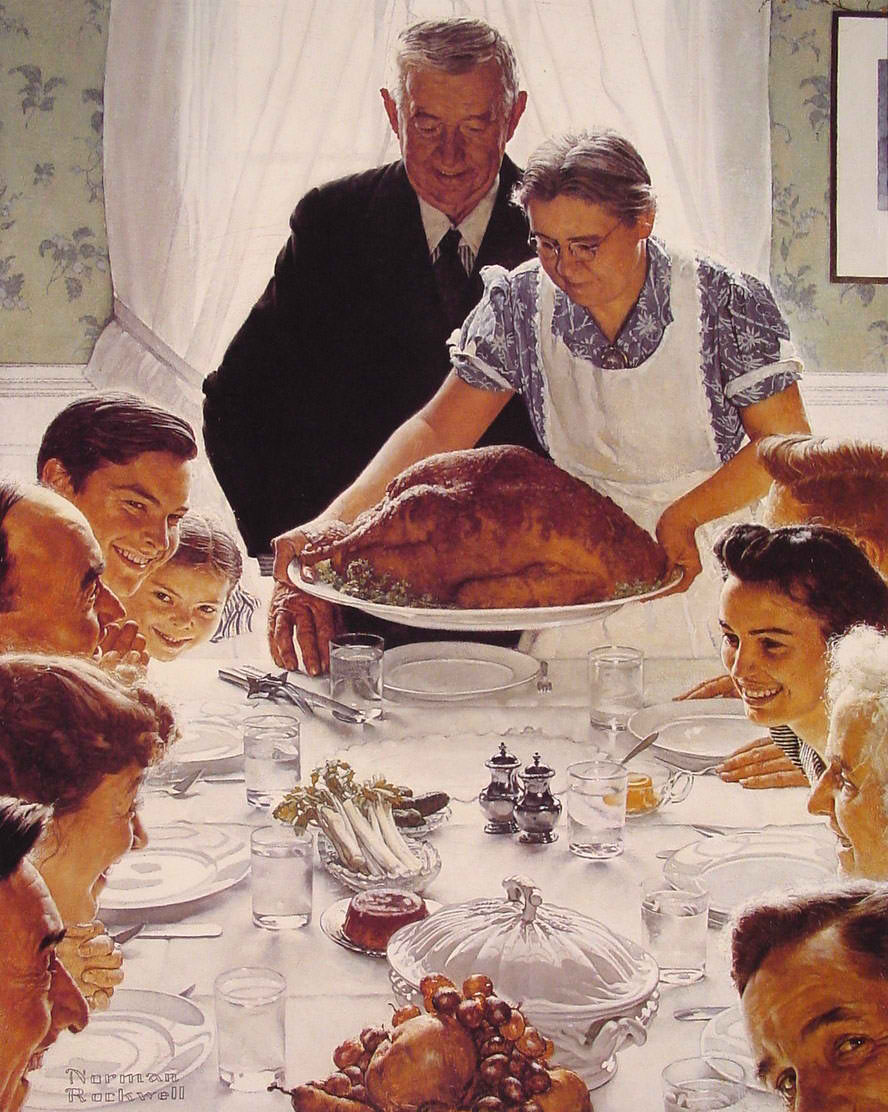
What I want is not the turkey on the platter, which seems too big for the spot where Grandma is placing it. And how is she carrying it anyway? My weak wrists would never make it, and the turkey would crash onto the floor. I’d let Grandpa carry it and smile sweetly, basking in the oohs and ahs.

What I want is Grandma herself. And Grandpa. How kind and cuddly they look.

The song associated with Thanksgiving is “Over the River and Through the Woods” which continues with “. . . to Grandmother’s house we go.” I never did such a thing. The only time I went to a grandparent’s house was at the time of Grandma Olive’s death and funeral, in Bayonne, New Jersey, when I was four. I played with toy cars in the steep driveway of my grandmother’s home on the bay. That’s what I remember.

When childhood friends said their grandma died, I thought, big deal. I had no heart pocket for such a relationship.

Grandpa Reuben is the only grandparent I remember, and he was not my mom’s biological dad. He was Grandma Olive’s second husband, who happened to be the cousin of her first, my mom’s dad Sidney. Olive didn’t have to change her last name when she married Reuben. I met Grandpa Reuben twice and was in love with him, the way a girl is in love with her grandpa. He was posh in suits but intensely kind.

Is there a word for being a grandchild orphan?

It is an odd and empty feeling not to have met my grandparents. But it is even odder now to contemplate that my grandparents did not meet all of their grandchildren. Dad’s dad was 70 when he was born; he fought in the Civil War in 1865; he died when Dad was 9. Dad’s mom died in the ‘50s before I was born, the last of eight kids. Mom’s biological dad Sidney was divorced from Grandma Olive and far away when we kids came along. Grandma Olive died when I was four; maybe she held me, I don’t remember. Then there was Grandpa Reuben, a fine substitute, but once on his jostling knees and once after his stroke in a wheelchair is it for memories.

Now, I’m going to be a grandma. When I first found out our daughter was pregnant, I thought I would need advice for my new role, since I had no grandparent memories to speak of. But guess what, there seems to be a heart pocket (think cargo pants) for this relationship after all. Strangely enough, while I’m loving my unborn grandson, it's almost like I'm sitting on my own lap, feeling loved.


Note about the painting: "Freedom from Want" was one of four "propaganda" posters by Norman Rockwell inspired by Theodore Roosevelt's speech to Congress January 6, 1941, urging the country to enter World War II. Read more here.
-
-

Sunday, November 06, 2011

Bedlam: A fresh look at an old horror

-
-
I am interested in how openly we share intimate stories of cancer, lupus, stroke, heart attack, and other physical maladies, but we are still fenced in about mental illness. Even Alzheimer’s is all right to discuss: it is a physical disease. But when it comes to mental disease, we hesitate to talk about disorders within our families, let alone personal struggles, feeling stigmatized by the mere association.

The days are still too close when people paid money to see the freak show: not bearded ladies, giants, Siamese twins or Elephant Men, but the insane. The wards of the infamous Bedlam asylum were salons for gawking, where fine ladies came to be entertained by raving lunatics.


Tom Rakewell ends up in Bedlam after a profligate life;
one painting in a series of paintings and engravings 
by William Hogarth called "The Rake's Progress"


Bedlam, now Bethlem Royal Hospital, is known as the oldest institution for mental patients (1247) and is notorious for its tortuous and dastardly treatment of patients. Remarkably, now it is a major center for research that promotes the best and most humane psychiatric practice and care. (See the history of Bedlam here.) But the word bedlam will always mean the uproar and chaos exemplified in that madhouse.

Eerily and perfectly timed for the end of Halloween week, two friends of mine have just opened an art exhibit of their Bedlam project. Robert Turney is an art photographer in the media of gelatin silver prints and wet-plate tintypes. (He happens also to be married to my professor, mentor and friend, Diane Wakoski.) Stephen Rachman is an American Studies scholar and chair of graduate studies in my department.

I really love Robert's photographs. Here is a sampling of his previous work, in gelatin silver prints.

Robert's gelatin silver prints


Rio Chama, New Mexico

Shack and Seatless Chair
Goldfield, Nevada

 New York #5

New York #9


New York #10


Robert's wet plate tintypes

And here is a sampling of Robert's more recent work, wet plate tintypes. To watch a stop motion video of Robert developing wet-plate collodian tintypes, twenty minutes shortened to two minutes, go here.


You know I love these two still lifes:


Moonflowers

Previously Robert and Steve collaborated on a subject happier than Bedlam: moonflowers. Robert created 10 x 10 inch gelatin silver photographs, shooting the moonflowers he grew potted in his wonderful town garden, at night. (Robert's garden is famous for certain rows of basil that went into Diane's legendary pesto with twenty-five, yes 25, cloves of garlic, that I ate with abandon, and after which Don would not sleep in the same room with me.)  Of course Robert photographed them at night, when they open. Robert's evening dance in his driveway with lights, medium format camera and moonflowers is enough to send a poet off for a week's contemplation, but combine it with Steve's gorgeous essay "Evening Glories," published with images of Robert's gelatin silver prints in the Red Cedar Review, and I am truly inspired. Below are a couple of Robert's gelatin silver moonflowers and excerpts from Steve's essay; see the twelve piece portfolio here. Read Steve's essay about Robert's moonflowers called "Evening Glories: Robert Turney's Moonflower Photographs" here:

"From 1999-2001, in this seasonal way, Turney pursued the flowers, under clouds, under stars, under the glowing coal of his cigarette. . . . It would be easy to misconstrue Turney’s moonflowers as conventionally romantic. . . . If they are romantic at all then they refer to the romance of ordinary beauty, sensuality, and sex. . . . "

~ excerpt from Steve Rachman's essay "Evening Glories"

Two of Robert Turney's gelatin silver prints of moonflowers:


"One secret of the moonflower photos lies in that Turney has photographed flowers as if they were movie stars from the 1930s and 40s. Think of Marlene Dietrich, Greta Garbo, and Martha Graham rendered by Edward Steichen . . ."    ~ Stephen Rachman, from "Evening Glories"


Bedlam

So what led these two to another textual and photographic partnership, this time about the insane asylum? Robert got to talking about the tintype self portraits he was developing, and Steve began to imagine a fiction about a psychiatrist and a patient, with tintype photography as therapy! The gallery show has single rows of tintype portraits of the patient (Robert himself, acting as G.G.), separated by text written by Steve: imagined journal entries by the psychiatric doctor about his patient G.G. He brings the patient into his studio, observes him under the lens, and sees an improvement in his demeanor. As you progress around the room, the patient in the portraits evolves from a state of violent agitation to calm melancholy.


A sampling of Robert's self portraits, as asylum patient G.G., with some of Steve's journal text,
progressing from extreme agitation to almost beatific calm:


"G.G. converses rationally on most subjects often with amiable feeling and charming manners; and yet he is incapable of going among people without severe mental agitation and reflection. G. G. exhibits great terror and excitement at the prospect of crowds."


". . . And this, it occurred to me, might in the end be what the camera reveals: I have always been struck by this phenomenon in cases of insanity. The insane pose for the sane in postures of madness—or feigned sanity—much as we pose for the camera."


(This one, above, is my favorite of Robert's tintypes;
it moves me in ways I cannot describe.)


Here are two fascinating pages of Stephen's text, which are especially interesting to me, in light of our discussions about translation and poetry at the Rilke blog. I hope you can read my images of them:


I asked Robert if he found himself in any emotional distress while photographing himself as Bedlam patient G.G. "No," he said. "I just made faces." And he asked if I knew the work of Sally Mann, who photographed her children, at home, in intimate poses, sometimes naked. Yes, I did. He said, "She is the only one who could take those photographs, they are her children, in her rural home." He said that these self portraits are like that. He was not exploiting a patient in a mental hospital. He was imagining himself as one, yet thankfully (?) with emotional distance.

For me, through Robert's faces I felt the pain of mental disease, and the terrible history of ostracism and stigma surrounding it. Yet I did not feel disturbed the way I anticipated feeling at Robert and Stephen's exhibit, linking to the ghosts in my own family's history, like that shadowy hand mysteriously moving between candlesticks in Robert's tintype, above. These were after all imagined portraits and journal entries. (Before attending the show, I thought Stephen had discovered real Bedlam documents.) There was jaunty jazz playing in the background. Stephen's fictional journal entries reflected sometimes humorous aspects of the patient's world, stepping over the sacred line of treating mental illness in only morose and somber terms. This kind of open exploration and artistic imagining can help us bust down fences about the ways we may feel threatened by the topic of mental disabilities.

But no matter how painful the topic—and reality—remains, we will still have the tender melancholy of moonflowers for comfort. In the end, perhaps it is only a full frontal look at ourselves, that includes our dark shadow side, that will heal us and make us whole.

"There is one that Turney doesn’t particularly care for (because the blossom appears more like a pansy than a moonflower) but might just as easily serve as an emblem of the study. It consists of a full frontal blossom. It is the moon almost full but for a petal edge bending into a deep shadow, the moon become a flower, a flower become the moon."    ~ Stephen Rachman, from "Morning Glories"


Robert Turney and Stephen Rachman,
Bedlam art exhibit at Scene Metrospace in East Lansing, Michigan
The show opened Friday and will run until December 11.

I hope you'll forgive me for going on a little longer in an already too-long post for a blog. While I stood before one journal entry at the exhibit, in dialog with my friend Reade about my findings in the bits of research I'd done on Bedlam and how people paid money to see patients writhe in torment, I told her about William Hogarth's painting "A Rake's Progress" at the top of the post. She then told me about the opera by Igor Stravinsky (libretto by lifelong friends and collaborators, the poets W. H. Auden and Chester Kallman) of the same name, based loosely on Hogarth's paintings and engravings of Tom Rakewell whose dissolute life led to the poorhouse, and then to Bedlam. Here is another imagined Bedlam story, in which Tom cavorts in London with a bad sort of fellow, Nick Shadow, who turns out to be the Devil. It is a moralistic tale, and Rakewell ends up in Bedlam, affirming the belief held by some that "For idle hearts and hands and minds the Devil finds a work to do." Dawn Upshaw sings a lullaby, "Gently, Little Boat" as Anne Trulove, Tom's betrothed, in this touching scene toward the end of the opera.


I'm grateful that psychiatrists like James Hillman, who continued the work of Carl Jung, have encouraged us to stop moralizing about our dark side, denying or rejecting our shadow selves. I want to keep that open and eager spirit alive and working, to gently love the shadows in myself and in others, or as Hillman puts it, to see generously:

Shadow is the very stuff of the soul, the interior darkness that pulls downward out of life and keeps one in relentless connection with the underworld. . . . the shadow may be reconceived. (James Hillman, The Dream and the Underworld)


. . . you find your genius by looking in the mirror of your life. Your visible image shows your inner truth, so when you're estimating others, what you see is what you get. It therefore becomes critically important to see generously, or you will get only what you see; to see sharply, so that you discern the mix of traits rather than a generalized lump; and to see deeply into dark shadows, or else you will be deceived.” (James Hillman, The Soul’s Code)
-
-
-

Friday, October 14, 2011

Tesselating

-
-

Our days run on in mundane, ordinary echoes of each other.
But think of honey from the tessellations of a honeycomb.
Consider the patient migration of a turtle in his symmetrical coat of arms.
What warm energy pushes within facsimiles and repetitions?
And what do their tiled borderings make possible,
like the scales of a snake’s skin that enable him
to undulate like an S of smoke sideways across the grass?


Eaglehawk Neck in Tasmania
one of the rare natural tesselations on the earth's surface;
see what natural movement formed it here.
Photo wiki commons

Drawings of symmetry by M.C. Escher; more here.


Tuesday, October 11, 2011

The Willow Ball!

-
-

As Winter gets ready to hook her come-hither finger around the neck of the sun, our inner rooms begin to come alive with the warm glow of lamps, candles, a fireplace or wood stove, and a samovar for tea. It can only mean that the holidays are coming, and to start the season off properly, the Lady of Willow Manor shall throw her annual ball where everyone is welcome, no one excluded. With our bloggy imaginations we can publish fantasies right here with our fingers, choosing our dream escort and rich attire to adorn our perfect bodies. We are able to dance like gods and goddesses all cyber-night long. Maybe every girl who dreams of her someday-wedding gown at age five is really just dreaming of a ball. Which of us dreamed of anything as elegant (and sizzingly fun!) as Willow's Ball? And guess what, it's on the night of the full moon. With or without a full moon, no matter how perfectly envisioned and planned, things can go wildly out of control; you would not believe the stories from years gone by! Half the fun is reading reports of goings-on in the comments at Willow's blog the night of the ball! (Last year's here.) The ball is tomorrow, there's still time to gather your accoutrements and wits. Your invitation is here; Tess will have a Mr. Linky up in the next 24 hours or so. I didn't think I was in the mood for a ball, and here I am going on and on!

Update: Willow has declared the ball open, there are already acres of cars parked and terabytes of blogs to visit. The festivities are here!


I chose the white lace dress with yellow trims by James Tissot, at top. The whole scene is evocative, and although the painting is titled The Gallery of HMS Calcutta (Portsmouth), some call it Remembrance of an Onboard Ball. A ball on a small ship? Wow. The dress looks good from this side, I think, the side you see on the dance floor.

As for who will go with me, I don't plan on taking a chaperone, as in Tissot's painting. Just a man.

I learned last year, with my fine escort Fitzwilliam Darcy, that a dreamily handsome and charming date is not necessarily the best choice. I barely got one dance with him. He was popular even with the men! Quite a change from the snob who turned his nose up at dancing in certain ballrooms. But he had lost his pride, and anyway he could see that at Willow's Ball, everyone is a fine dance partner.

Because Leo Tolstoy has been my close companion for over a year (I hold him affectionately in my hands: War and Peace), after fingering through potential escorts in my heart's little black book, I realized he would be the perfect partner for the ball. After he picks me up in his skiff and we bob up river to the Manor, he will settle in with a book in a nook. (I offered him my Kindle—not Nook—to re-read W and P, but he said he's more interested in Rilke's letters from Russia.)

Tolstoy is not one for balls, despite his noble upbringing. But his choice of an ascetic life, he assures me, will not cause him undue discomfort in the presence of so much frivolous ruffle and draped satin. He craves the music. He is well on in years, and tired, so he will sit and listen, or read, while I dance the night away with whomever I wish. When I am fagged from waltzes and fox trots and need a few moments' rest, he will be waiting in his radiant corner to captivate me in conversation. Don’t worry about him being bored and neglected. See how he holds the chair open next to him? You too can sit and carry on discourse with Monsieur Tolstoy when you need a rest. I will concede this so long as I can cut in. I doubt very much that the chair will be empty for long, as we will all need a rest now and then, and hushed dialog about many things. (I want to tell him, for instance, what came of his epistolary acquaintance with Mohandas Gandhi a few decades after they corresponded for a year about nonviolent resistance until the end of his life in 1910.) At Tess’s Willow Ball, all things are possible, because while Monsieur Tolstoy speaks Russian and French, and I don't, we will magically understand one another.


Notes about the paintings:

The Gallery of HMS Calcutta (Portsmouth), circa 1876, sometimes called Remembrance of an Onboard Ball, by James Tissot, Tate collection

"Tissot often painted a man with two women in order to explore the subtle nuances of flirtation and attraction through body language and facial expression. Here a chaperone separates the young naval officer from the object of his attentions, the woman hiding her enjoyment of his flirtation behind her fan. Tissot focuses here on the boundaries of Victorian propriety and social convention, and their transgression. The languid pose of the nearest woman, and Tissot’s frank concentration on her fashionable hour-glass figure, inevitably led to the picture being criticised when it was first exhibited. The author Henry James dismissed it as ‘hard, vulgar and banal’." (From the display caption August 2004)

Leo Tolstoy, by Leonid Pasternak

This painting of my companion was done by Leonid Pasternak, father of the poet and novelist Boris Pasternak, best known for his novel Doctor Zhivago. Pasternak was a friend of Tolstoy's and painted illustrations for Tolstoy's novels. More info about Pasternak in a short bit I wrote for the Rilke blog here.

André Rieu is rehearsing Shostakovich's Russian Waltz for tomorrow night!


-
-