alskuefhaih
asoiefh
Showing posts with label moon. Show all posts

Tuesday, March 13, 2012

Sap at night

-
-


Sap at night

Before budding begins,
the last pure stream of the maple
drops into the bucket-moon
sweet and uncluttered


Postscript note: Because of early warm temperatures, Don has been harvesting sap from eight buckets on four six maple trees since early February. Normally he would not begin tapping until late February. Sap is sweet until buds begin to form, then it becomes bitter and can't be used. We have noticed buds starting to sprout on all the trees and shrubs, and with the expectation of very warm weather this week (70°F, 20°C), he only has a few days of sap left to carry in. It takes 40 gallons of sap to boil into one gallon of sweet, buttery maple syrup. So far, he has boiled about that much, with another fourth of that to go. Depending on conditions, some days a five-gallon bucket is full in just one day's sap run.


-
-

Thursday, March 08, 2012

Poem: Hitting the Mark

-
-
Hitting the Mark

"My barn having
burned to the ground, I can see the moon."
      ~ old Chinese proverb


In the whole big
field of blue
the sun hits
the bull’s-eye moon.

Down here
my face’s albedo
mimics something
like it in return.

Night by night
turn after turn
the arrow light
finds its mark

and like a climbing,
stumbling goat
I aim my horn
this way and that

to snag that light
in flight. Maybe
one long and
maundering day

from here, when
they open the gate
for home, the sun
will put up his

arrows, the moon
her shield, I my bow-
shaped horn, and we'll
dissolve in sleep.

Until then I'll jump
the fence and like that old
cow make a scene
over the moon.


March 2012


Painting: "Not far from the sun, moon and the stars" by Jean Arp
-
-

Wednesday, January 11, 2012

Poem: Cactus bloom . . .

-
-
Cactus bloom picks up where the moon leaves off

Pink spark rising
after the sleepless Night
upheld the moon
(her shield d’amour).
Now, hold the field of day.

Then, at day's end,
dive like Joan with sword,
immanently mortal,
perpetually young,
softly arcing to earth
like the moon along her
battle for the night sky.


January 2012


-
-

Sunday, November 27, 2011

Poem: Blue hour

-
-


Blue hour

The tall spruce with wild
but silent upcurled arms
conducts the cool dark night
on a track of wind into morning’s
thinness; like God, and I lying still
under him; my moon-white face
a lit candle floating in the font
of the hot tub; the wind on my face
and arms as if prayers whispered
from a distant train; rumbling through
the entire outdoor room; the barn,
house, rocking bamboo, the hunters
asleep next door; nowhere is there
a smell of death, no deer hung,
no blood, no mouse in the mouth
of a snowy owl; this is God’s early
hour when lips are still closed, when
prayers for the dying are snored
through noses like praise out the back
door; when the doe rises on groggy
legs, believing the tender leaves
are still wet, still green.
 

We learned early Thanksgiving (Thursday) morning that my 83-year-old mother-in-law was suffering in a crisis of renal infection that had spread into her blood. It has been touch and go since then; Friday we thought we might lose her, but thanks to her medical team who made difficult decisions that saved her, and to her strength of will, she is recovering steadily, though still in ICU. This poem comes out of my morning prayers for her. "Blue Hour" — in the French "l'Heure Bleue" — called Madrugada in Spanish and Portuguese; it is the twilight between the full dark of night and the light of day. For me it is a magic hour, when occasionally dark possibilities clutch from the night, but more often my thoughts lean toward brightness and hope, toward everyday miracles in the large and small cycles of life.  
-
-

Saturday, July 30, 2011

Poem: The Moon's Question

-
-


The Moon's Question


The half-cut moon gleams across the dock
like a riddle of God, and I, a sphinx, guard

the entrance. On the lake’s shore, bound
in soil, a stone shines, a pearl in the dark,

like the tensile eye of Isaac from the altar,
bulging, uncloven, watching for an angel

to illumine the question of surrender, at the
moment of fullness when two realities exist —

one rising, shining, alive, and one falling back,
hidden, the seemingly silent side of the moon.


Illustration of the moonhair woman by Arthur Rackham

-

Saturday, March 19, 2011

The River and the Moon

-
-


I walked along the river at noon.
The trunks of tall black trees stood their ground
along the banks, while the river pulled backward.
On I walked up current, toward the river’s past.

I thought of the moon, a world away, invisible.
I walked and thought how different
my life would be without her, how the world
would come loose at its edges. I wanted her,

the way I want my mother’s face, knowing full well
her time is past. We scatter our petals into flowing water,
loving the mystery of disappearance. They say
that tonight she will return, oh so close, larger even, than life.


Listen to a podcast of this poem here.
-
-

Wednesday, December 30, 2009

blue moon

-
-

I think it's interesting that la luna is considered womanly and fertile, partly because of its alignment with the menstrual cycle, yet we talk about the moon's face as the Man in the Moon. It is the sun that rules supremely and is associated with men - Apollo, Ra, Surya - they ride a chariot of war across the sky. (There is a Norse sun goddess, Sol Sunna, who also rides such a chariot. And the Hittites had Arinna, sun & fertility goddess.)

Quickly after winter solstice and Christmas celebrations - which originated in sun worship called Saturnalia - we have a Blue Moon. My color enhanced version is just a silly literal blue moon. You can read about the origins of the term blue moon at wiki. Whether it's the thirteenth full moon of the year, or the second full moon of the month - like this December with one on the 2nd and another on the 31st - folklore says when the face is blue, he talks to those in his light.

For a long time the way people have listened to Nature is through myths. I am a terrible student of classical mythology - Roman or Greek - let alone Aztec, Ojibwe, Hindu, Arabian or Norse and all those Wagnerian Brünnhildes. First my high school Latin teacher tried to drill Zeus and Aphrodite into my head. Then my university teacher Diane (lunar goddess) Wakoski - who centers her personal story in classical myths when she writes poems - taught me what she could. I would like to know more so that when I read an allusion to mythical characters I can understand the connection without looking it up. Sometimes I think all I do is look things up, and I want to know something without looking it up. Don't get me wrong, I'm devotedly grateful to Google, wiki, imdb and pantheon.

One character I always seem to come across in my readings is Persephone, whose story is a way of imagining the origin of winter. Hades, god of the Underworld, kidnapped her because she was so beautiful. Her mother Demeter, goddess of the harvest - or Earth Mother - wandered the earth looking for her, and the earth ceased to be fertile in her grief. At last Hermes went down to get Persephone back at Zeus' bidding, and he reluctantly let her go, but not before giving Persephone a pomegranate, which she ate seeds from, and it tied her to the Underworld forever for half the year, which is winter in Demeter's grief. She spends half the year with her mother, and that is summer.


Back to the moon. Diana is the moon goddess, or goddess of nature, fertility and childbirth (that menstrual cycle thing). Somehow she managed to protect those realms without getting directly involved in the messy affairs of people. In fact she was so uninvolved she was a virgin. Strange to be the protector of childbirth and fertility as a virgin, no? In myths the male gods may be the supreme rulers most of the time, but goddesses manage to mold and salvage something out of harsh circumstances the guy gods created.

Of course the moon and earth aren't female or the sun male; it's a way to think of the moon as the lesser light that is only reflecting the true source of light, the sun, in terms which have for too long been the parallel for women and men in society. I tend to be earthbound in what I can see, hear and feel and lack imagination and fantasy. We watched "Bridge to Terebithia" the other night, and I didn't much enjoy it. I don't have a desire to see "Avatar." But in spite of my distant quiet "virgin" observation of fantastical creations, it's nice to go out in the moonlight and let something other than facts speak to me. Maybe there really is something not in our heads that the moon says (he or she) when I get up in the night and see that blue light softly falling on the sofa the barn and the maples that isn't spoken in the light of day.

Poems sometimes arrive in the night. And dreams. Fears and worries too. But I don't think I've ever been afraid when the moon shone blue through the window. To me it says, Be still.

I wish you a wonderful New Year.


~Top image is the Sturgeon Moon shot August 28, 2007, processed blue in PhotoScape
~Persephone image by blackeri
~Diana image by Marinshe
~Bottom image shot when I was out in Lesley's kayak before sunrise, October 7, 2006; look closely at the .
.....horizon on the left side for geese in the water
-
-

Friday, October 09, 2009

What else?

-
-


What Else?

First you're born and
you're alive-
What else?

Over the years
you hear confessions
that you tuck into
your swaddling clothes

Eventually you wear them
like a fleece
of deep forest green
collar up

A cozy suspicion
clothes you
the way night
clothes the moon

And what is that moon
if not a comfort
in the deep blanket
of your life

the stone that might help you
remember
What else?


Tuesday, June 02, 2009

season of the black locust - "the poverty tree"

-
-

In a morning walk to the meadow, feet soaked with dew, I was surprised to find trees in flower that I hadn't seen closely yet in our five previous springs at the farm. Don't ask me how that is possible, but it's true. It wasn't that the dozen or so trees hadn't blossomed, because I had smelled their eye-closing fragrance. But I had not really noticed the blossoms closely or even remembered the trees' name.

I didn't know this is the season of the black locust.

See how like pea blossoms they are, falling in racemes. In fact black locust trees are in the Faboideae subfamily of the pea family Fabaceae. At times these blossoms are swarmed by bees; black locust is one of the prime sources of honey in the U.S.

We could call them bees' peas. Wish I'd caught a bee in the frame.


It's named black locust because of its dark bark, which rises in deep furrows. You know how Abe Lincoln famously chopped wood? Well it was black locust logs he chopped - probably for fence posts and the famous log cabin, because it's very sturdy wood. The locust part was named mistakenly for what sustained St. John the Baptist in the wilderness - but this tree is native to North America. The correct tree of "honey and locust" fame is the locust tree of Spain - Ceratonia siliqua (carob tree).


Because the tree grows where nothing else will (it has nitrogen-fixing bacteria in its root system), poet Gerald Stern said:

My identity with that tree has something to do with Judasism and with persecution. The tree is short-lived--forty years maybe--it's asymmetrical, considered ugly, worthless. Farmers value it only as a source of fence posts. People, when they buy land, chop them down to replace them with shade trees--I love that tree, I identify with it; it's my poverty tree. I sometimes see the concentration camp number on the forearm, or forelimb.

x x x x - from Making the Light Come, by Jane Somerville


See how the black branches stand out when the white blossoms are spread full. It sure isn't ugly if you ask me.


You're right to exclaim: How did you miss that!


Robinia pseudoacacia information gathered at wiki.

Here is a sweet poem by Gerald Stern in his choppy, talky style:

The Preacher [As if the one tree you love]

As if the one tree you love so well and hardly
can embrace it is so huge so that with-
out it there might be a hole in the universe
explains how the killing of any one thing can
likewise make a hole except that without
its existence there was neither a hole nor not a hole
I said to my friend Peter and after he left
I walked to the tree again and put my arms
around the trunk or almost did for I was
embracing it preparatory should I say
to its dying for it was one of the many
dying trees along my river mainly
sycamore and locust—

Finish reading the long-ish poem here . . .

Tuesday, November 25, 2008

open air


Almost every day I read a few lines of Rumi. His words inspire me to be the authority of my own life. Remember when you wrote in school "I think" and your teacher told you to remove that phrase and just say what you think? I tried writing this poem that way, and in the manner of Rumi. I don't mean to compare myself to him, he's incomparable. But I'm happy to be a copyist of what inspires me, like painting students who copy masterpieces in the Louvre. Amazing! I'm not comparing myself to them either.


Open Air


Go outside at night
somewhere with trees.
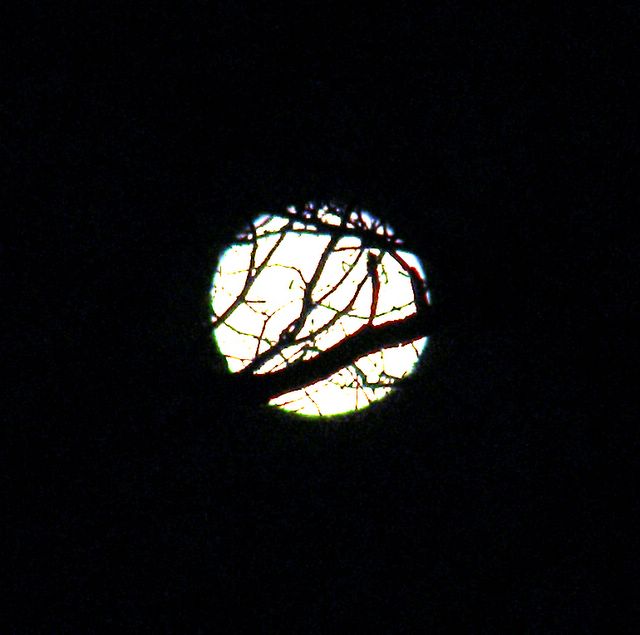
See how the branches open to the moon.

There is love that is not hot.
Even on the coldest nights
its arms are open.

It is the warmth inside
that keeps you alive.
The sun in your blood as in a leaf
and in the branch
after the leaf turns red
and falls.

Close your eyes. Feel how like love
are the cool fingers of the wind
on your face.


- Ruth M.


Happy Thanksgiving Thursday.

Wednesday, February 20, 2008

eclipse


Click on images to enlarge (I think one doesn't work though). I also posted the last image at my photoblog flying.

It was perfectly clear. What are the chances of that for two total eclipses in a row within seven months?

It was cold, but not as cold as I expected. It was just 10°F (-11°C).

See how in the second image, where the eclipse is partial, the shadow is black. But as the shadow of the earth eclipsed the moon further, the shadow became more red, being affected by the earth's atmosphere, and because the light faded, allowing the red to be more visible. So the final image is when the moon is almost totally eclipsed, even though it just looks like a red harvest moon. I didn't see any turquoise, as the NASA site suggested in yesterday's post. It was too cold to stay out for the whole totality (until 10:30pm or so).

Tuesday, February 19, 2008

lunar


Tomorrow, Wednesday, February 20 will be the last total lunar eclipse for the next three years.
-
This photo was from the last one in August 2007. It was a nice warm clear early morning with coffee and my Bishop. Tomorrow from 8:30pm until midnight when the eclipse will transpire, it will be 3°F (-17°C) and possibly cloudy. Rather than sit with coffee and my tripod, I'll likely have to stand the tripod and snap, then take the camera back into the house until the next phase. If the camera batteries get too cold, the camera won't function. Not to speak of me.
-
This NASA site says the moon will turn red (because of the earth's atmosphere) and there might even be a bit of turquoise around the edges (passing through the ozone layer, the red will be filtered out, making it look turquoise blue). The turquoise should show up at the beginning and ending of the totality, around 10:01 and 10:51pm EST. "Maximum beauty" should be around 10:26pm EST.
-
I'm sorry to say my friends in India won't be able to see much of this eclipse, apparently.
-
I'm hoping for a clear sky and a functioning camera.

Wednesday, January 23, 2008

perspective


Listening to presidential hopefuls and starting to write short fiction this week have me thinking about perspective, and perception. Oh, and two posts ago hearing your differing opinions about Zaha Hadid's modern aluminum and glass architectural concept in a row of traditional brick university buildings.

Barack Obama is our savior. Barack Obama is no different from any other politician. He could transform the image of America. He will not change anything.

Eckhart Tolle said that if you were born into precisely the same circumstances as another person, you would make the same choices they have made. Well, you could never prove that one, could you?

What creates our perspective? How much of it is conscious choice? How much is default reaction based on how we were raised? How much is based on educating ourselves, being exposed to someone else's perspective?

If I could zoom in on one little piece of the canvas in this evolving life, I'd like to work on taking myself less seriously while being more open to someone else's perspective.

How can I take myself too seriously when yesterday I:
  • made coffee - water in, grounds in - without putting the pot in its spot: yeah, coffee overflowing onto the floor
  • getting ready to color my own hair last night, instead of mixing the activating cream with the TINT, I mixed it with the CONDITIONER, in other words, a waste of seven bucks and an hour's time

It was a full moon yesterday. Does that change things?

Wednesday, August 29, 2007

Sturgeon moon


This top photo is the full "sturgeon moon" at the end of the day Tuesday, August 28, in other words, last night.

I love the Native American names of the full moons. You can see the list of 2007 full moons and more information about why they're named as they are here. I'll at least list them for you:

January - Full Wolf Moon
February - Full Snow Moon
March - Full Worm Moon
April - Full Pink Moon
May - Full Flower Moon
May 31 this year there was a "Blue Moon" (when there is more than one full moon in a month; there are around 41 months with two full moons every century) - "Although the name suggests that to have two Full Moons in a single month is a rather rare occurrence (happening "just once in a . . . "), it actually occurs once about every three years on average."
June - Full Strawberry Moon
July - Full Buck Moon
August - Full Sturgeon Moon
September - Full Harvest Moon
October - Full Hunter's Moon
November - Full Beaver's Moon
December - Full Cold Moon


The rest of the photos are earlier, of the total lunar eclipse early yesterday morning, the same day, between 5 and 6am. (I posted three of these in a triptych on my photoblog.)

I knew the total lunar eclipse was coming, and I almost forgot to go outside to watch. But then I opened my computer to do my blogroll and emails, and my default Internet home page is http://www.msu.edu/, and there was a reminder to watch the total lunar eclipse on top of one of the MSU parking ramps. Thank you!


Bishop sat on my lap in the front yard while I sipped coffee and snapped away with the auto timer. How fortunate there wasn't a cloud in the sky.

Friday, August 18, 2006

Going direct


Posted by Picasa

Warning: I'm going to rant philosophically.

Osho said “the sunrise is not a word.” In other words, the word is not the thing itself. When we know the name of something, do we then know anything about it?

What is the moon in this photo? Its light is not the moon, is it? The light is reflected from the sun.

Have you ever looked at an apple (or anything) for 15 minutes straight? Without judgment or description, like “Oh, that’s a beautiful apple, so shiny and a great shade of red, and I'm sure it will be crispy and delicious”? Just look at it and see it for what it is?

To come directly into contact with what is – what does that mean?

How can an old chair worth just a few dollars in Arles, France, be transformed into a chair worth millions of dollars when painted by Van Gogh? (idea from Eckhart Tolle’s book A New Earth) What is the chair’s essence? What is there beyond the chair that gives it meaning? Or maybe, within the chair?

What do I take time to meditate upon and contemplate, for greater understanding? Anything?

I find these questions compelling, because I am overwhelmed by the barrage of information I encounter every day. There is so much I want to give my attention to, but haven’t the time. I don’t really know anything that I do not know directly.

Knowing something or someone, without separation, is that possible?


Posted by Picasa Van Gogh's "Chair with Pipe"