alskuefhaih
asoiefh
Showing posts with label aging. Show all posts

Saturday, March 10, 2012

When you feel imprisoned

-
-
graveyard in Kinsale, Ireland

The Prisoner

I
My hand has one gesture left:
to push things away.
From the rock dampness drips
on old stones.

This dripping is all I can hear.
My heart keeps pace
with the drops falling
and sinks away with them.

If the drops fall faster
an animal might come to drink.
Somewhere it is brighter than this—
but what do we know.

~ Rainer Maria Rilke
Part II of "The Prisoner" is here
translated by Anita Barrows and Joanna Macy

For some time now the word I focus on in meditation is free. I don't meditate daily; maybe a couple times a week. I close my eyes for a few minutes, focus on my breath, and while I exhale, I hear, see and feel the word free. Sometimes I'm up in the sky, with birds, coasting on air currents. Sometimes free appears as a prayer for someone. But it had not occurred to me until now that it was an unconscious "choice," this meditation word, in a time when I am bumping up against the stone walls of physical limitations for the first time in my life.

I've been slowed by hand-wrist-arm-shoulder-neck pain since December. These are repetitive strain injuries, the result of twenty years at a computer at work. I am getting manipulations by an osteopath, and learning the Alexander technique, in hopes of relieving it. Dictation software has been a mixed blessing; often I get more tension using it than not when I have to repeat a sentence many times. Last month I was also diagnosed with hypothyroidism, which accounts for some of my fatigue, and soon I'll go on the lowest dosage of medication for it, taking a prescription drug long term for the first time. I'm 55. (The natural remedies for hypothyroidism include avoiding cruciferous vegetables—broccoli, cauliflower, kale, spinach—because they block the thyroid hormone. I would rather not give these up, so I'm hoping the low dose of levothyroxine is enough to restore my metabolism and does not result in the dizzy or "drunk" feeling some people encounter. My bad cholesterol has shot up from 193 to 243, which is another reason it seems important to go on this med.)

Learning the Alexander technique from my teacher Elinore is about unlearning bad habits of hunching my shoulders, holding tension, rushing into space, pulling my head back onto my spine, affecting every movement of my body in painful ways. (This 10 minute video explains quite well how the Alexander technique helps pupils regain balance and lightness.) For years I've thrust forward into the next thing, as if life was an emergency.

More than the pain, what bothers me most is having to slow down. "Somewhere it is brighter than this," says the prisoner in Rilke's poem. Truly, somewhere it is much darker than this where I am. But this has taken some adjustment. I am no longer quick, and youthful. Suddenly I act like an old woman, not the plan I had when I became a grandma in January.

We just finished watching "Little Dorrit" the BBC series on Netflix DVDs. It's the Dickens story of a young woman who lives in a debtors' prison in London with her father. She was born there and knows nothing different. She even loves her life caring for her father and prefers it to the new life of wealth that comes to them suddenly. Her father Mr. Dorrit suffers daily from his imprisonment and degradation, however, believing he is worthy of something far better. But once he arrives at the something far better, he finds no peace there either.

I take inspiration from Little Amy Dorrit. Inside the stone walls of Marshallsea Prison for Debt she angelically loves and cares for her father in spite of his irksome resistance and condescension. Like Dickens' characters often are, she is probably a caricature of what a human can really be, in this case softer and more philanthropically positive than seems possible in her situation. But even she could not adjust to the seismic changes that came with enormous wealth. We humans are creatures of habit, even when our habits keep us confined.

"We need to stop trying so hard and allow our lives to unfold naturally," says Richard Brennan in my Alexander book. For some years now I've been doing spiritual work to learn to love what is and what comes, which is helping me with this physical learning.  To not "push it away" as the prisoner in Rilke's poem, now that's the real work.

For another take on changing habits, see a new post at sparks & mirrors, "To deliver oneself up to silence."
-
-

Tuesday, February 28, 2012

Poem: Bamboo in Winter

-
-

Bamboo in Winter

Wind blurs the bamboo branches into 
     spinning ribbons of two-toned sage.
It is a singular being with root-stalks rattling
     out of the snowed and heavy ground.
Or is it the other bamboo sticks' chiming I hear?
     The ones the children tied with shells and twine
when Summer jumped the wind with lissome limbs?

Winter bones now rattle the wind, unfastened
     in tatters. Skeletal bells from porch hooks
keep flapping. What did we carry from Summer,
     in the hands of the children?
Keep on, keep on, call the bamboo chimes
     to their living kin across Winter’s yard.
Bend quietly, dear sons and daughters.
     Bend lithely, while you can. And the shells clap
their hands like cymbals, hearing
     Summer's tide in the sound of the wind.


February 2012


-
-

Wednesday, November 02, 2011

Poem: My hair returns

I-
-
I have no idea why I am writing and posting so frequently these days. I hope it is not a hardship for you. But why should it be? You don't have to read, or comment, or nothin'. But I gotta keep this pen pumping for some reason. Whatever the lasting value (and that doesn't matter much to me) I am compelled. If you come and read, bless you, and bless you if you don't! Let it flow on by.

Here is a little bit of surreal whimsy as the sun rises over my shoulder.

My hair returns


My hair flows
out my office and
down the corridor at work,
the old, high-ceilinged university hall
with industrial lights hanging down
like dangle-pearl earrings,
not bright enough to read by.
Sadly, the old hall will come down
next year after its hundred-somethings.

My hair is gold again, in rushing waves
like in my college youth
not unlike these students who wait
outside my door
lined up in bands and ribbons
on their stiff wooden chairs on
the banks of my river-hair, with
bright white apples on their laps—
a virtual picnic!

They come for advice,
as if I am a scryer,
and my hair the crystal river
running on to their future life.

Did I tell you, I stopped straightening it
with flattening irons and other
falsehoods? And now my curls,
when you come in at last
to my room from the hall,
are the wiry wisps of a crone
who skips upriver
on the backs of stones.


Here is a photo of the top of my curlier-than-ever-it-was head at my office desk, taken by my own white apple mac magic camera. I haven't stopped coloring over the gray yet, maybe that will come. If I had Don's salt-and-pepper hair, I wouldn't think twice. Humor me, I'm taking this aging thing in baby steps.


Oh look, I just realized how like Stanisław Wyspiański's sewer I am!
Do you think she's really a redhead,
or did she (or he) color her hair too?


 -
-

Monday, October 24, 2011

Poem: Stacking in October

-
-


Thanks for relishing with me the beautiful time at the lake with Inge, what we think of as our autumn writing retreat. Besides our luxurious hours reading and conversing, I did not do any new writing there, but I did edit, shuffle and organize poems for the book I want to self publish. I was encouraged because I got farther than I expected, with even a tentative title and cover design. I have much to learn about publishing, ISBNs, and all sorts of things I would rather not be bothered about. A dear blog friend has been of great help and is giving me time on the phone today to answer questions. While I don't care all that much about "marketing" this book, seeing it as more of a small offering to those who have asked for something like this from me (so very kindly), I suppose it would be negligent of me to press ahead without ample forethought.

Anyway, this poem was written after returning home. It almost sounds as though I could use another retreat, but don't worry: winter is coming, with plenty of time for naps near the wood stove on weekends.


Stacking in October


For a few minutes’ interlude from Sunday rest
I stack firewood in the corncrib from the pile
at its door. Wrists ache. My body is heated
from within by menopausal hot flashes. I am not
exhilarated by the exercise, feeling my age. I must
sweep off the curled, dried leaves on the porch
before the wicker and potted wilting impatiens
are mere crispy mounds, like bracken covered in kudzu.
So, too, I must pluck hairs from my chin. How like
honey the sun flavors the quiet air—my one clear hope
and pleasure in these autumn minutes, until powder
rifles and shotguns ring peals from neighboring land.
Prizes are claimed, herds thinned. Winter is coming
with its losses, its sleep, and its recycled comforts.


Poetry should be heard.


-
-

Monday, September 05, 2011

Ode to a Pear

-
-


Ode to a pear


Venus rustic,
buddha seated,
bottomly knob,
overturned
not hardly —

who’s to say
your ripening,
still on the sill,
ponderously
unburdened,

all sweet pale,
by a window glazed,
till just tooth
tender, into
a perfection of age

awe-full-y to
decay approaching,
nearly one day
fluid, fermented —

who is to say that then
just before that end
you are not
the fruit
of all
most choice,
delectably
surrendered?


Poetry should be heard.

Did you know that pears don't ripen on the tree? They should be picked full sized and firm, set in the fridge for a day or two to prolong them, then set out at room temperature to ripen in a few more days. Best eaten the day before starting to rot, still sweet, almost dissolved more than chewed, in a quick minute.


-
-

Thursday, May 26, 2011

Poem: The Arrival

-
-


The Arrival

On a smooth spring day
    they alighted
    like the wispy feet of a wren
    hugging the twig of my upper lip —

the descent of my mother’s pout-wrinkles
    there in the rear view mirror
    on me.

I thought perhaps I could perpetuate
    a smile
    from then
      on

spreading them
    as beautifully as a bird’s wing in flight
    across my face
    and no one
    would be the wiser.

Then it came to me

that we are given every feather
    for flight

though we tuck them in
    so deftly
       satinly
          shiningly

All the feathers
    there at birth!
    Even in the lentil bean
    in the womb
    all the feathers

for flying arcs
    across the face of the sun
    setting as he does
    taking with him
    the rays of our young smile

-
-


Monday, May 23, 2011

Poem: This Tired Body

-
-


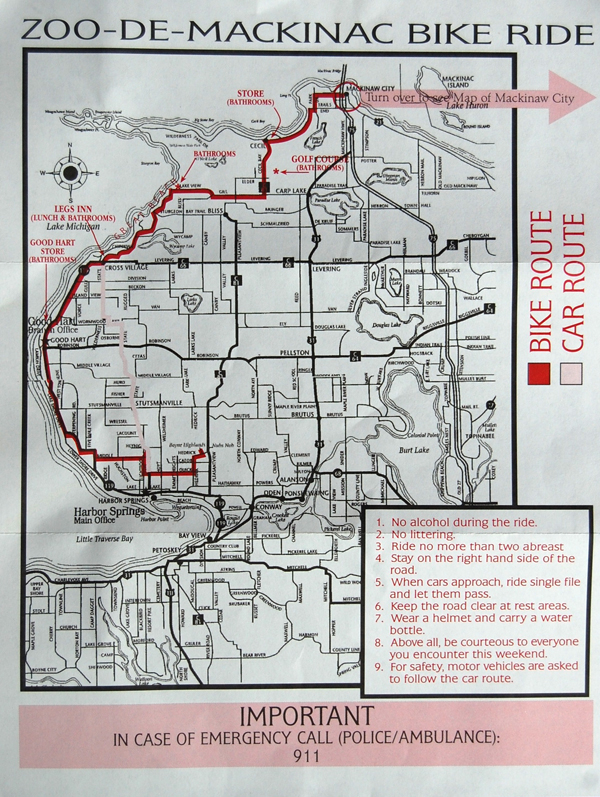
We rode with 3,000 or so people in the Zoo-de-Mack from Boyne Highlands to Mackinaw City Saturday. Mackinaw City is where the Mackinaw Bridge crosses from the Lower Peninsula of Michigan into the Upper Peninsula. It was wonderful to ride and play with our son Peter and his girlfriend for the weekend, one of the last times before they move to Los Angeles in a couple of weeks. (I am trying not to think about that.)

This Tired Body

This tired body settles into stillness
as if it is trillium floating
on the forest floor that I biked past for hours
two days ago. It did not appear to be reaching

for sun, the layered white spread
of it lying in repose under hemlocks like tossed
handkerchiefs waiting to be picked
up and returned to the fainting ladies
who dropped them.

Today the memory of climbing, of coasting, of steadying on,
coalesces with the bed of silence inside,
gently tugging me back to myself, to the rest
only I can grant, the surrender to age,
to the uphill bodily climb
of what remains of my life.

If only the mind, and the heart
were all of what it takes to live
and this tired body
were as light as tissue
petals reaching, finding pockets of light
even in deepest shadow.

I pedaled 51 miles, a triumph,
and now I languish, a weary kind of human
who could coast toward a finish line, but I want instead
to find sun at the leafy edges of my fingernails, wind
in my gnatty eyelashes, to keep finding a heart in
steady, pedaling thumps, pushing on,
pointing toward the light inside this life.


trillium for miles

coasting downhill, ahhhh

 trillium covered the forest floor


Mackinaw Bridge

-
-

Saturday, April 17, 2010

another kind of tea bag

-
-

. . . "for the roses
Had the look of flowers that are looked at."
T.S.Eliot
4 quartets
p 14

Looking in my fluorescent magnifying mirror,
dabbing dots of concealer on the bags
under my eyes as the magazine for aging women
who want to stay beautiful shows,
I suddenly feel the register in the room's music
deepen and know that my Auntie Sue is sitting behind me
on the worn chair that was Aunt Edith's. O both these women
had eye bags to beat the band.
"Aunt" Edith, my mother's stepmother
with that gene that creates these features on your face
like a nose or a mouth or a chin but that don't
start growing until somewhere after 40 about the time earlobes
also seem to have grown longer,
Aunt Edith whose pedigree and provenance I know nothing of
and never cared to because I didn't like her. But
Auntie Sue, my dad's sister, was different.
The woman had the most glorious eye bosooms
in the history of womankind,
reminding me of the women gathering tea
on the hills by the Black Sea,
their soft burlap tea bag carried in front
like one large breast
growing as they stuffed in more leaves.
I wish I'd had more time with her,
because what she carried in her eye bags was fragrant,
like that black tea, not poisoned like Aunt Edith's Chernobyl tea bags.
Auntie Sue whose humor was her pedigree and when you aimed
a camera her way said she'd break it,
whom all of us adored and never had enough of in her 92 years.
She might as well have lived by the Black Sea she was so far away
in Virginia where tobacco leaves grow but here she is, sitting behind me!
- smiling her wryness as I try to cover what we got from her mother,
and she says: One day you won't be able to cover them Ruthie
but just be sure that what you carry in them is fragrant.


*Note: On April 26, 1986 the worst nuclear accident in history occurred in Chernobyl, Ukraine (then USSR) and the radioactive cloud it released contaminated the tea growing along the Black Sea in Turkey, which was while we lived in Istanbul. There was a tea crisis, and the tea already in stores sold out in a day.